Using Vegetable Fibre to Reduce Plant-Protection Product Residues in the Musts
Photo: État du Valais
The use of vegetable fibre can reduce plant-protection product residues by up to 80% in white musts, with a more limited effect in red musts.. The method can be applied in cellar, as a complement to the responsible use of products in the vineyard.
The ‘Viticulture and Oenology’ Experimental Station carried out a study evaluating the efficacy of vegetable fibre (VF) and bentonite (B) in reducing plant-protection products (PPPs) in Petite Arvine and Syrah musts. The study was conducted at laboratory and cellar level on the 2022 and 2023 harvests. In the laboratory, the VF achieves a 33 to 96% reduction in residues depending on the molecule, whilst the effect of the bentonite is negligeable. The combination ‘VF + B’ brings no additional improvement. Fermentation kintetics are preserved overall, although a slowdown can be observed with the bentonite.
Confirmed efficacy of vegetable fibre for white musts in cellar
The results for the white musts in 2022 obtained in the cellar show that settling alone reduces residues by around 20%. The addition of VF causes a marked improvement in efficacy (up to 85% for boscalid), enabling the complete elimination of certain molecules (mandipropamid, cyazofamid) with no detectable organoleptic changes. In 2023, the VF completely eliminated all measurable residues. B remains ineffective in all tested conditions (Fig. A).
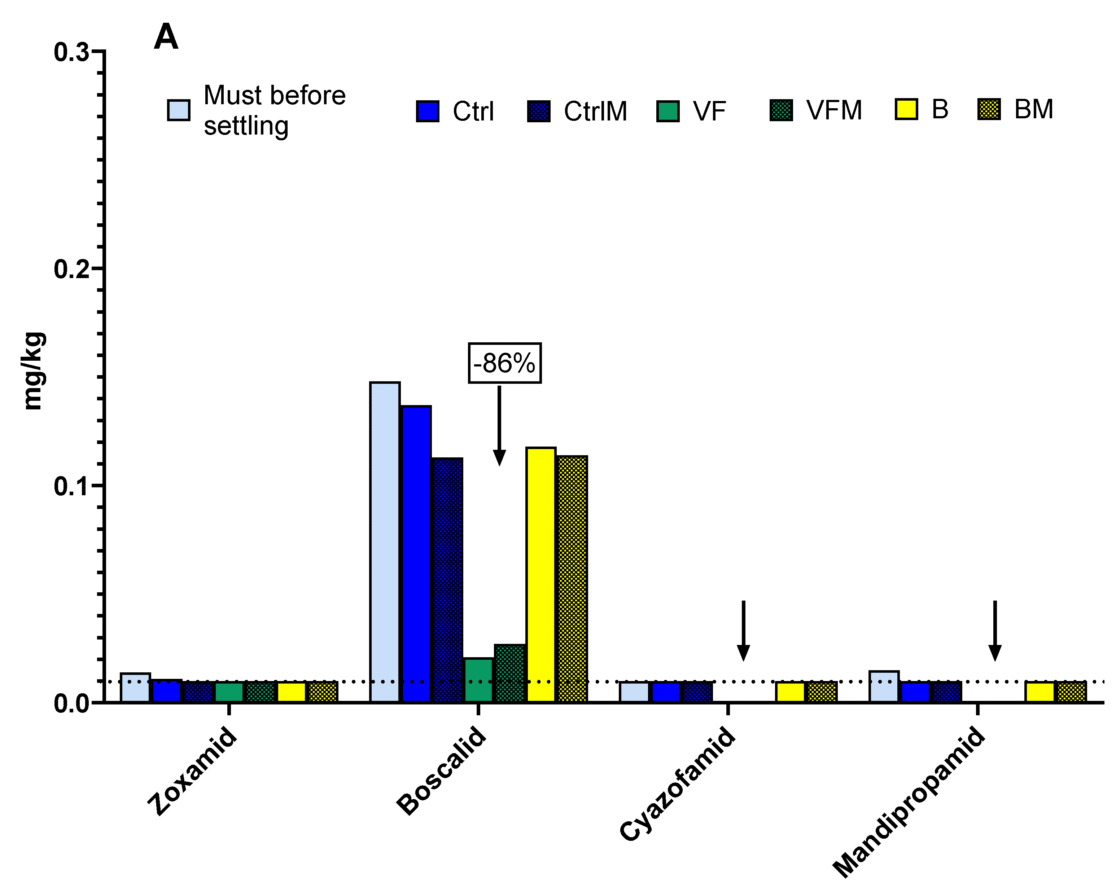
Vegetable fibre; B: Bentonites; M: Use of Dynawine static mixer.
Reduced efficacy of vegetable fibre for red musts in cellar
With red musts, fermentation reduces residues by 40 to 100%, limiting the impact of the VF. Results vary according to harvest: a modest reduction in 2022 (boscalid) and an absence of effect in 2023. Organoleptic differences and variations in certain parameters (end of malolactic fermentation, anthocyanin content)) were also observed. The application of VF during settling of the white musts is thus effective and can easily be incorporated into the vinification process, particularly during harvests characterised by heavy pressure from pests and late treatments. With red musts, direct use of VF is not recommended; an application on finished, filtered wine is more appropriate. This method represents an additional tool for the sensible management of PPPs at the vine, rather than a replacement for it.
Conclusions
- Vegetable fibre used to settle white musts effectively reduces the number and quantity of PPP residues, but is not effective in red musts, where it may even modify organoleptic perception.
- The use of vegetable fibre is especially appropriate after numerous PPP treatments (particularly after veraison).
- The reduction of PPP residues in cellar is not a substitute for the judicious use of PPPs in the vineyard.
Bibliographical reference
Réduction des résidus phytosanitaires dans les moûts par l’utilisation de fibres végétales.