White Clover and Smooth-stalked Meadow Grass: Four New Recommendations
Photo: Daniel Suter,
Agroscope
White clover and smooth-stalked meadow grass make a significant contribution to persistence and grazeability in high-yielding fodder-production mixtures. Based on the 2022 to 2024 variety trials, Agroscope can now recommend two new varieties for each of these species.
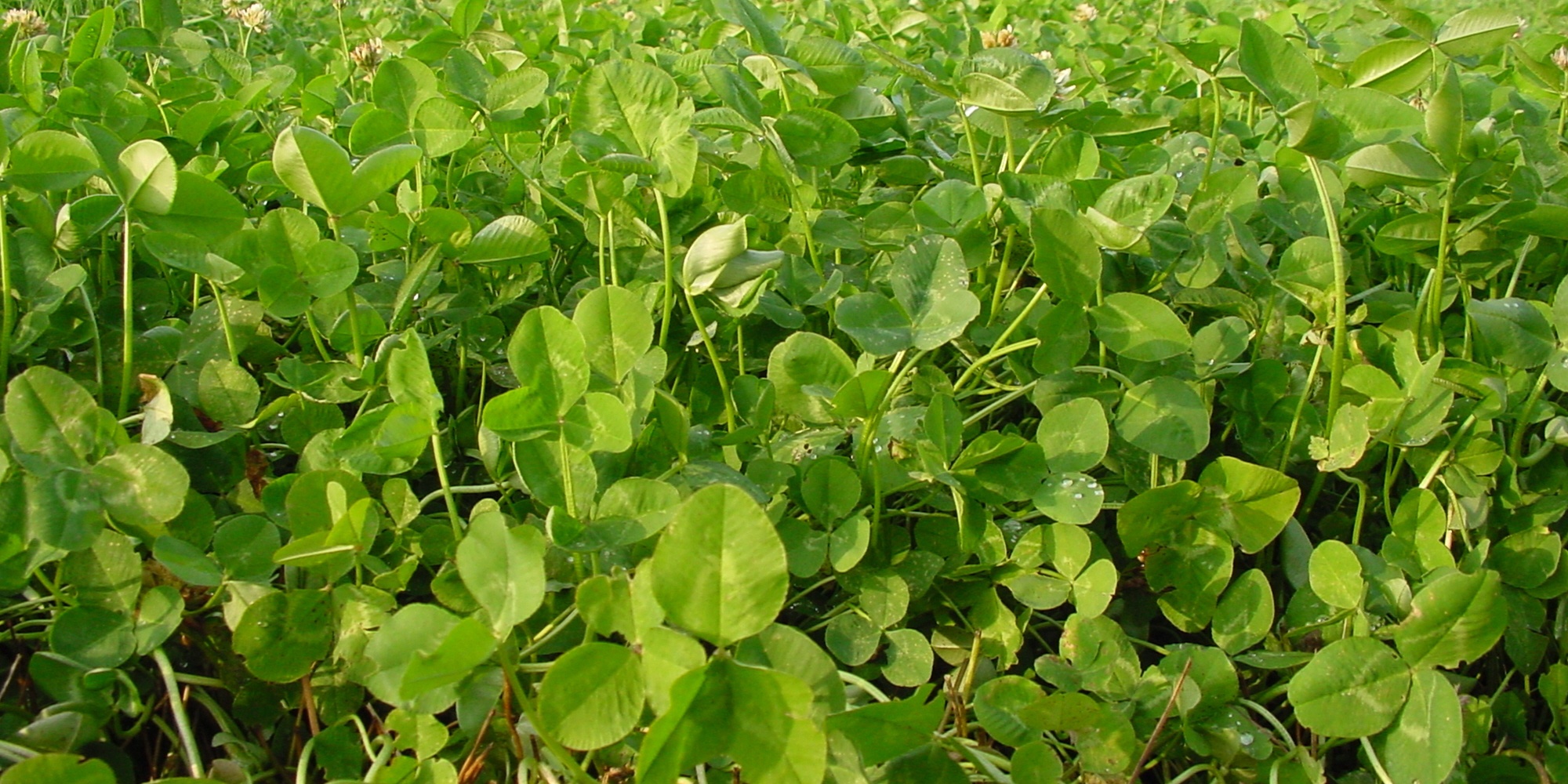
White clover (Trifolium repens L.) is the quintessential fodder legume for long-term intensive use. Thanks to its stolons it is hardwearing and ideally suited to grazing. Grass swards with white clover are characterised by better fodder quality and palatability. Since it fixes atmospheric nitrogen, white clover also reduces the need for nitrogen fertilisers. There are white clover varieties that can release large amounts of prussic acid during digestion, which can adversely affect livestock health. Consequently, close attention is paid to this characteristic during variety testing.
Smooth-stalked meadow grass (Poa pratensis L.) is just as suitable for intensive use as white clover. It has rhizomes that form a dense, hardwearing sward, making it likewise suitable for long-term mixtures, especially for pastures. Unfortunately, the slow juvenile development of smooth-stalked meadow grass means that it can only fulful its task in the sward after some time. Both species require high-yielding, competitive and robust varieties with maximum disease resistance if this potential is to be exploited.
28 varieties field-tested
From 2022 to 2024 at five sites on the Swiss Central Plateau and two at higher altitudes, Agroscope tested the suitability of ten new cultivars and nine recommended varieties of white clover for fodder production under Swiss conditions. With smooth-stalked meadow grass, seven new cultivars and two recommended varieties were tested at four sites on the Swiss Central Plateau and one at higher locations. Juvenile development, yield, vigour, resistance to leaf diseases, winter-hardiness, persistence, and suitability for cultivation at higher altitudes were assessed, as were fodder digestibility in the case of smooth-stalked meadow grass and release of prussic acid in the case of white clover.
Four new recommendations
The white clover varieties ‘Melital’ from Belgium and ‘Minona’, a Swiss-bred variety, are now recommended. Their high yields and outstanding winter-hardiness make them standout choices. In addition, ‘Melital’ impresses with its excellent resistance to leaf diseases, whilst ‘Minona’ stands out for to its juvenile development and suitability for cultivation at higher altitudes. Both varieties are of the small-to-medium-leaved type.
The smooth-stalked meadow grasses ‘Sextonis’ and ‘Sialis’ are two further new recommendations, both Swiss-bred varieties. ‘Sextonis’ stands out for yield, competitive ability and winter-hardiness, ‘Sialis’ for digestibility. Both varieties also impress with their good resistance to leaf diseases and remarkable persistence. All four new recommendations substantially improve the recommended range.
Struck off the list
The previously recommended white-clover variety ‘Rabbani’ has lost its recommendation due to its unsatisfactory performance. Consequently, it may only be used as a recommended variety until the end of 2027.
Agroscope’s variety recommendations
Agroscope regularly tests different fodder-plant varieties in order to provide the Swiss agricultural sector with the latest reliable variety recommendations. Published every two years, the List of Recommended Varieties of Fodder Plants forms the basis for developing the best seed mixtures, and is an essential guidebook for the Swiss seed sector.
Conclusions
- In high-yielding fodder-production mixtures, white clover and smooth-stalked meadow grass ensure dense, hardwearing and persistent swards for the longer term.
- Between 2022 and 2024, Agroscope tested a total of 19 varieties of white clover and nine varieties of smooth-stalked meadow grass.
- Four new cultivars, the white clover varieties ‘Melital’ and ‘Minona’ and the smooth-stalked meadow grasses ‘Sextonis’ and ‘Sialis’, are new recommendations.
- The previously recommended white clover variety ‘Rabbani’ has been struck off the list of recommended varieties.
- The quality of the range of varieties of white clover and smooth-stalked meadow grass has been further enhanced by the new recommendations.
Bibliographical reference
Weissklee und Wiesenrispengras: Vier neue Sorten empfohlen.