Nitrogen Fertilisation in Vegetable Production: Which Measurement Methods Work?
Photo: Michael Gugger,
Agroscope
How reliable are modern methods of measuring nitrogen fertilisation in vegetable production? Field trials show that established methods are still more effective – and reveal scope for reduced fertilisation without yield loss.
In vegetable production, precise nitrogen fertilisation is key to ensuring high yields and quality and at the same time minimising harmful environmental impacts such as nitrate leaching. However, established laboratory-based measurement methods are time-consuming and relatively expensive, and are therefore seldom used in practice. New digital measuring instruments promise a faster, more affordable and thus more easily implementable means of determining nitrogen status.
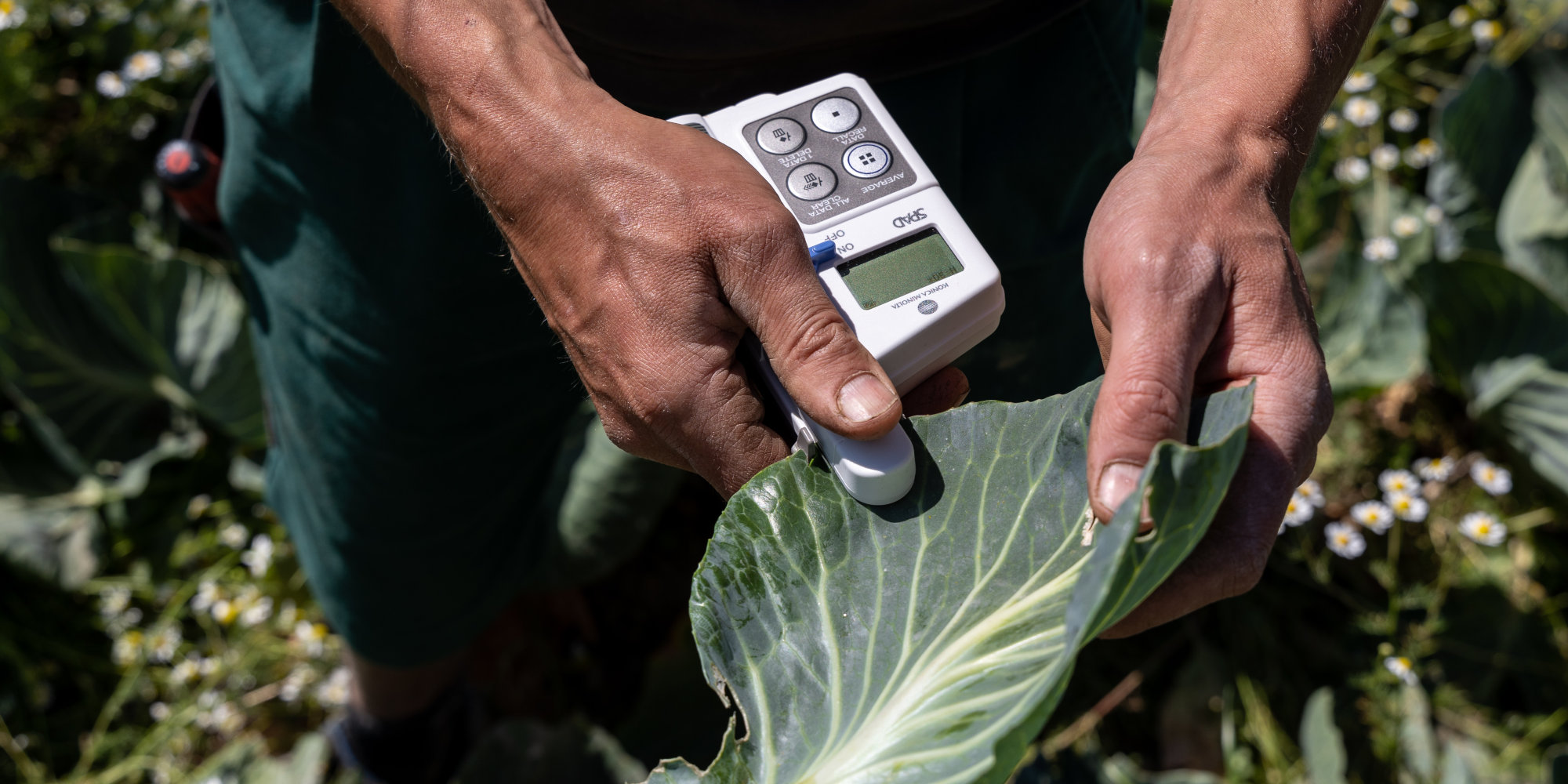
Different methods of determining the nitrogen supply were investigated during a three-year field trial (2022–2024): conventional laboratory analysis of soil mineral nitrogen (Nmin), plant sap analysis, a sensor system (Stenon-Farmlab) and measurement of chlorophyll absorption (SPAD). The trials were performed under practical field conditions in a crop rotation with celeriac, white cabbage, and lettuce and included different nitrogen fertilisation levels.
Soil and sap analysis proved most accurate
The results clearly show that conventional Nmin laboratory analysis and plant sap analysis were the most effective at differentiating fertilisation levels. Sap analysis in particular proved robust and frequently correlated well with the laboratory values of the Nmin soil samples. In contrast, the tested sensor system (Stenon-Farmlab) failed to adequately identify the fertilisation levels and showed major discrepancies in some cases. SPAD measurements also produced inconsistent results and are currently of limited value for determining the fertilisation status.
No additional yield with higher fertiliser inputs
Notably, fertiliser inputs that exceeded the recommendations of the Principles of Agricultural Crop Fertilisation in Switzerland GRUD/PRIF (the standard Swiss reference for good fertiliser practice) did not produce significant additional yields. In several trial years and crops, even reduced fertiliser levels or unfertilised variants were comparable with the PRIF standard level in terms of yield. This indicates high nitrogen replenishment from the soil at the trial site and illustrates the potential for fertiliser savings and/or reductions, especially in the summer months, when supported by suitable measurement methods.
The findings also highlight the fact that site conditions, weather, tillage and preceding crops have a considerable impact on nitrogen availability and dynamics. Consequently, a one-time measurement is not sufficient; repeated, site-specific assessments are required. Computer models (e.g. N-Expert) and estimation methods (corrected standard) can further support sound fertilisation decisions.
Conclusions
- Currently, laboratory analysis of soil mineral nitrogen (Nmin) and plant sap analysis remain the most reliable instruments for assessing the nitrogen supply in vegetable crops.
- The Stenon-Farmlab sensor system and SPAD chlorophyll measurement did not provide satisfactory results.
- Fertiliser inputs exceeding the recommended Swiss standard did not produce significant additional yields in many cases. This indicates the potential to reduce nitrogen fertilisation without yield losses if suitable analysis methods are used.
- The authors recommend promoting site-specific fertiliser strategies and supporting the development of practical rapid tests to increase resource efficiency and environmental protection.
Bibliographical reference
Stickstoffdüngung im Gemüsebau: Präzision und Praktikabilität aktueller Messinstrumente.