Spot-Spraying Substantially Reduces Plant Protection Product Use and Environmental Risks in Vegetable Production
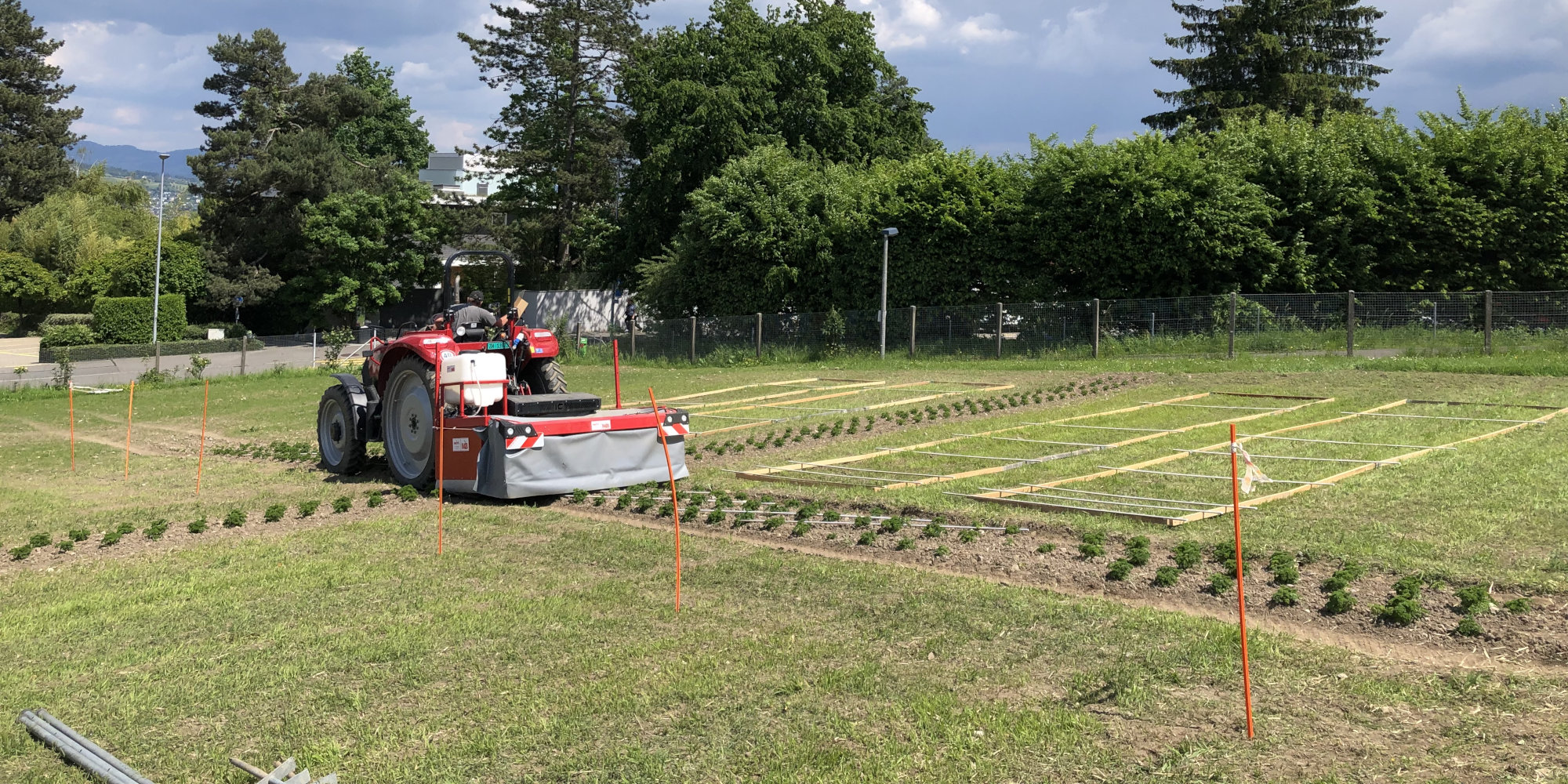
Photo: Thomas Poiger,
Agroscope
Camera-guided spot-spraying enables a targeted application of plant protection products (PPPs) on individual plants. Field trials confirm that this can result in PPP savings and a significant reduction in runoff and drift.
Plant protection products (PPPs) play a key role in safeguarding agricultural yields. At the same time, they face increasing criticism as environmental pollutants. Conventional broadcast application of fungicides and insecticides in vegetable crops may result in a substantial proportion of the spray landing off-target on the soil rather than on the plants, particularly in widely spaced row crops and during early stages of growth.
Targeted application reduces risk
Consequently, application methods that apply PPPs only where they are needed are becoming increasingly important. One highly promising technology is camera-guided spot-spraying, in which individual plants are identified and treated with pinpoint accuracy.
The present study investigated the extent to which spot-spraying can reduce PPP use as well as runoff and drift. Coordinated by the Swiss Central Office for Vegetable Production (SZG), the project was conducted in collaboration with partners from research, agricultural practice and industry, and funded by the Federal Office for Agriculture.
For the project, field trials were conducted in various vegetable crops and a comprehensive dataset of relevant crop parameters was developed drawing on detailed plant measurements. Based on this data, the PPP savings and runoff reduction potential from spot-spraying were modelled across different growth stages. In addition, drift trials were conducted with two spot-spraying systems – the Steketee Prototype II and the ARA by Ecorobotix.
Promising field trials
The field trials in selected vegetable crops showed a high savings potential. For celeriac and parsley, spot-spraying reduced the proportion of treated area to 15–20%, leading to PPP savings of 80–85%. With band spraying, savings of 58–71% were achieved.
Crop and growth stage are key
Modelling with additional vegetable crops confirmed that PPP savings are strongly dependent on crop type and growth stage. During early crop growth stages, high savings are possible: with lettuce, for example, PPP savings of over 90% are possible shortly after planting. As soil cover increases, this savings potential declines. For fast-growing crops like lettuce, savings fall to below 50% within a few weeks; with slow-growing crops such as celeriac, however, high savings are possible over a relatively long period.
Runoff potential significantly reduced
The effects of the technology on runoff potential were particularly striking. Since this approach reduces the amount of active ingredients which would otherwise land off-target on the soil during a broadcast treatment, reductions in potential runoff can in some cases even exceed PPP savings. Spot-spraying reduced the runoff potential by up to 93%, band-spraying by up to 78%.
Very little drift
Extremely low drift values were measured during drift trials with the Steketee Prototype II and the ARA by Ecorobotix. With both spot-spraying systems, drift deposition fell below 0.01% of the amount applied, and hence over 99% below the reference values. Targeted application, spraying-unit shielding and low nozzle heights were key factors.
Conclusions
- Spot-spraying can reduce PPP use in early growth stages of vegetable crops by up to 85%, and in certain cases even up to 95%.
- In the trials, spot-spraying reduced runoff potential by up to 93%, band-spraying by up to 78%.
- Spot-spraying can significantly reduce the risk of spray drift. At distances of up to 9m from the field edge, a drift reduction of over 99% compared to the reference values was achieved.
- The crop parameter dataset developed by the project offers the potential for modelling practical application scenarios and could serve as a basis for ecotoxicological assessments.
- The findings support the integration of targeted application techniques into regulatory frameworks as a recognised risk-mitigation measure.
- Targeted application methods represent a promising tool for resouce-efficient and sustainable plant protection, particularly in Swiss vegetable production.
Bibliographical reference
Nachhaltiger Gemüsebau: Bestimmung der Pflanzenschutzmittel-Einträge in die Umwelt mit Spotspraying (2023-2026) - Abschlussbericht.