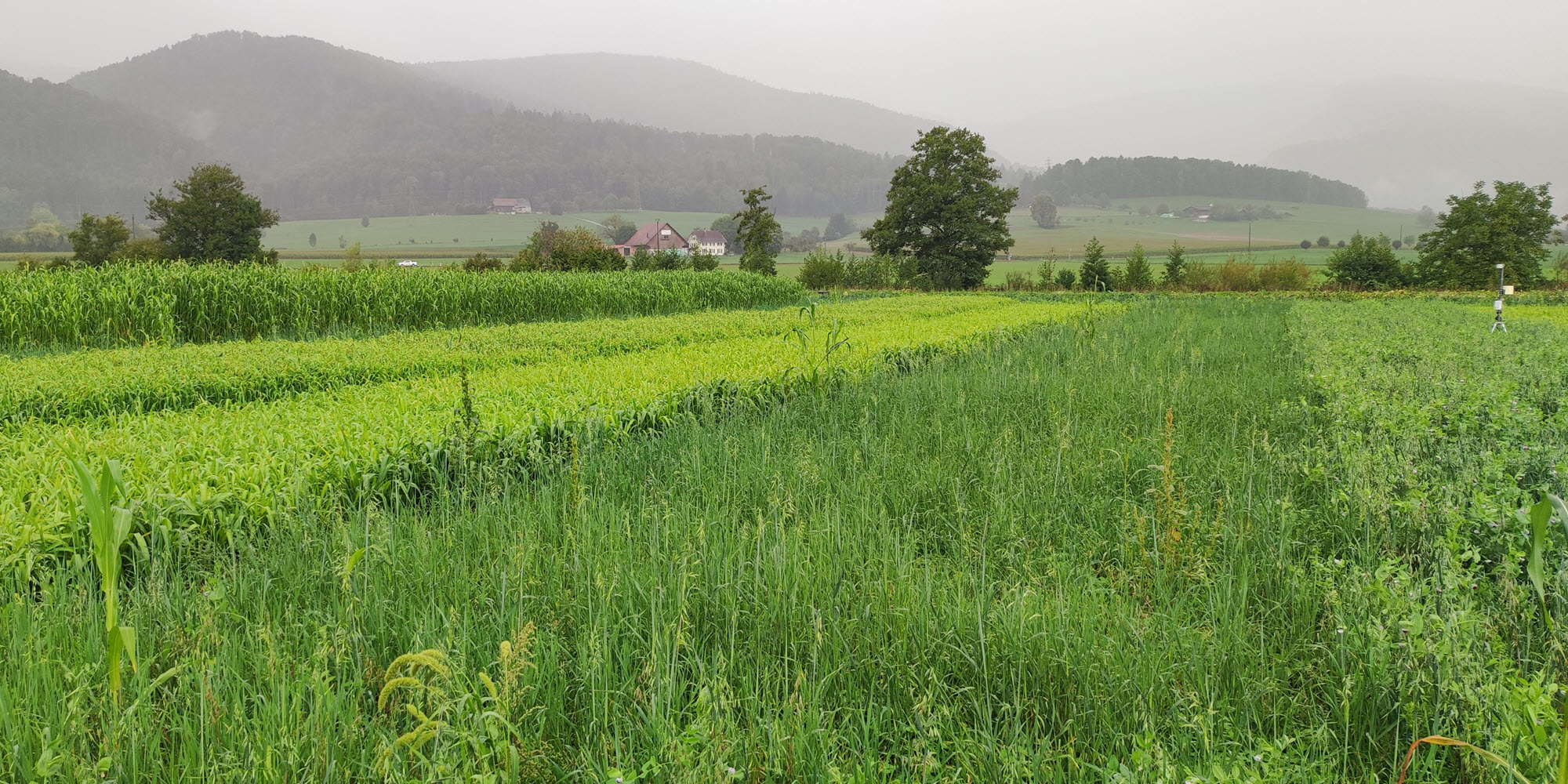
Performance of Drought-adapted Forage Catch Crops
Photo: Massimiliano Probo,
Agroscope
Faced with climate change that undermines the stability of forage production, the introduction of more-drought-tolerant catch crops represents an adaptive strategy with a high likelihood of success in safeguarding livestock feed supplies.
Forage production can be substantially reduced by climate change, particularly due to ever-more-frequent and extreme summer droughts alternating with more intense rains. This situation jeopardises livestock feed supply security and undermines the resilience of Swiss animal husbandry systems. Faced with these challenges, incorporating drought-tolerant catch crops into the rotation appears to be a promising adaptive strategy.
Five drought-adapted catch crops tested
In the Jura region, this study compared a conventional catch crop – oat-forage pea-summer vetch (OPV) – with five other catch crops identified as drought-adapted, within the context of contrasting summer climatic conditions observed in 2021 and 2022: hybrid forage sorghum with annual clovers, Sudan grass, black oat with crimson clover, foxtail millet, and pearl millet.
Dry-matter yield differed between the catch crops tested, although not between years. On average, foxtail millet, hybrid forage sorghum with annual clovers and the OPV recorded the highest dry matter (DM) yield, with values ranging between 26 and 29 dt DM per ha.
The OPV had the highest nitrogenous matter (NM) content (172 g NM / kg DM) as well as the lowest fibre values, on a par with the hybrid forage sorghum with annual clovers. For both these methods, crude protein yields per hectare averaged 430 kg NM, which could help maintain the protein autonomy of the farms.
Hybrid forage sorghum with annual clovers: a viable alternative to OPV
Hybrid forage sorghum in association with annual clovers proved a viable alternative to OPV: well adapted to contrasting climatic conditions, it ensured satisfactory yields as well as satisfactory forage quality, thanks to hybrid forage sorghum’s drought tolerance and the complementarity of its growth with that of annual clovers. By contrast, the yields and forage quality of the catch crops based on black oat, Sudan grass and pearl millet were unsatisfactory within the context of this trial.
Conclusions
- Hybrid forage sorghum grown in association with annual clovers constitutes a viable alternative to OPV, offering both satisfactory yields and satisfactory forage quality as well as production stability under contrasting climatic conditions.
- The inclusion of legumes in the mixtures encourages an increase in crude protein content, thanks to the functional complementarity of the different forage species.
- Catch-crop diversification can help spread the risks associated with unforeseeable climatic events, thus strengthening the resilience of forage systems.
Bibliographical reference
Performance de cultures dérobées fourragères adaptées aux conditions sèches.