Plant Diversity to Cope with Increased Drought Risk in Grasslands
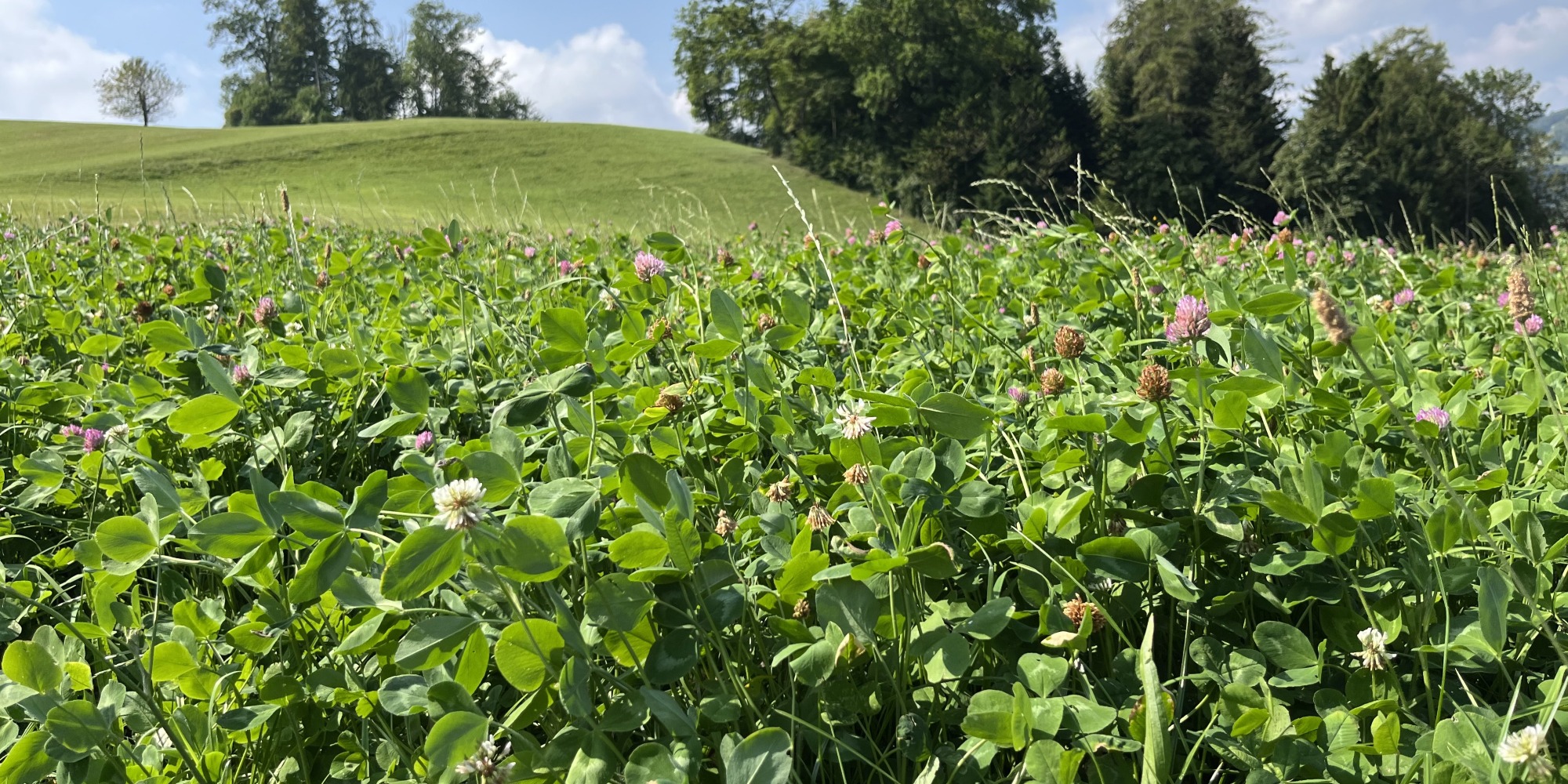
Photo: Nicolas Alou
Plant species diversity in intensively managed grasslands can act like a natural insurance against drought risk by reducing production variability. This reduction persists even at increased drought risks.
Covering more than 60% of agricultural lands worldwide, meadows and pastures play a key role in forage production whilst being exposed to climatic risks. Faced with these risks, of which drought is one of the most serious, farmers can increase the resilience of their farms by using ‘natural insurance’ approaches based on plant diversity. Such strategies not only help stabilise yields but also have additional environmental benefits.
An economic approach treating diversity as natural insurance policy
A study conducted by ETHZ and Agroscope adopted an economic approach to plant diversity, viewing it as a portfolio of assets that reduces production variability, thus conferring an ‘insurance value’. The analysis combines a theoretical framework with empirical modelling based on experimental data from grasslands in Switzerland composed of high-performing species commonly used in intensively managed grasslands. The study identifies two stabilising mechanisms – an ‘ecological effect’ and a ‘statistical averaging effect’ – and highlights the role of species asynchrony, that is the temporal complementarity in growth between species.
Plant diversity reduces risks due to a statistical effect
The results show that plant diversity tends to reduce yield variance, thus confirming its role as a production stabiliser. However, the study highlights an increased risk of extreme yield losses in the more diversified systems (seen with a more negative ‘skewness’). Despite this, the overall benefit from diversification remains positive: the insurance value of plant diversity is significant and persists even when drought risks increase.
The analysis also reveals that the statistical averaging effect plays a more important role in determining the insurance value than direct ecological interactions between species. In other words, it is diversification per se – the act of combining species that react differently – that contributes most to grassland economic stability.
An integrated perspective for sustainable grassland management
These results confirm that plant diversity can constitute a risk-management instrument. The study highlights the potential of this strategy to strengthen the resilience of agricultural systems in the face of drought – a major asset in the context of climate change.
These conclusions are also relevant for public decision-makers, suggesting that the promotion of more diversified intensively managed grasslands could be incorporated into agriculture and climate policies, not only for environmental reasons, but also as an economic stabilisation tool.
Conclusions
- Plant species diversity in intensively managed grasslands can act as a natural insurance, reducing production variability and offering a measurable economic value.
- The insurance effect is mainly due to a statistical averaging effect rather than to direct ecological interactions between species.
- Even at increased drought risks, the insurance value of diversity remains positive.
- These findings suggest that plant diversity should be given greater recognition in agricultural and climate policies to leverage economic and environmental resilience.
Bibliographical reference
Plant diversity to cope with increased drought risk in grasslands.