VITISWISS Platform Assessment 2019-2021: Very Low Residues in Swiss Wines
Photo: Carole Parodi,
Agroscope
The 451 wines analysed on the VITISWISS national platform for monitoring plant-protection product residues show that Swiss wines possess a high level of quality, with only two cases of non-compliance.
Aiming to enable Swiss producers to guarantee the quality of their wines in terms of plant-protection product residues and research solutions for limiting the presence of residues in wine, VITISWISS – the Swiss federation for the development of a sustainable wine sector – decided in 2019 to set up a national platform to monitor plant-protection product residues in collaboration with institutional and professional partners. Between 2019 and 2021, the platform, which offers a centralised and standardised analysis procedure, dealt with 160 active substances and metabolites comprising 37 herbicides, 50 insecticides and 73 fungicides.
Wines compliant with the legal requirements
Of the total of 451 bottles of wine originating from organic or integrated production (IP) that were analysed, 449 or 99.6% met the legal requirements. Only two wines, i.e. 0.4% of the samples, were declared non-compliant following the identification of two products not authorised for use on grapevine in Switzerland. Overall, 26 other authorised active substances or metabolites were detected at values above the practical quantitation limit (PQL) of 0.01 mg/l. On average, the residue values recorded for these different products were nearly 30 times lower than the legal values. The analyses also identified 19 additional molecules at trace levels below the PQL.
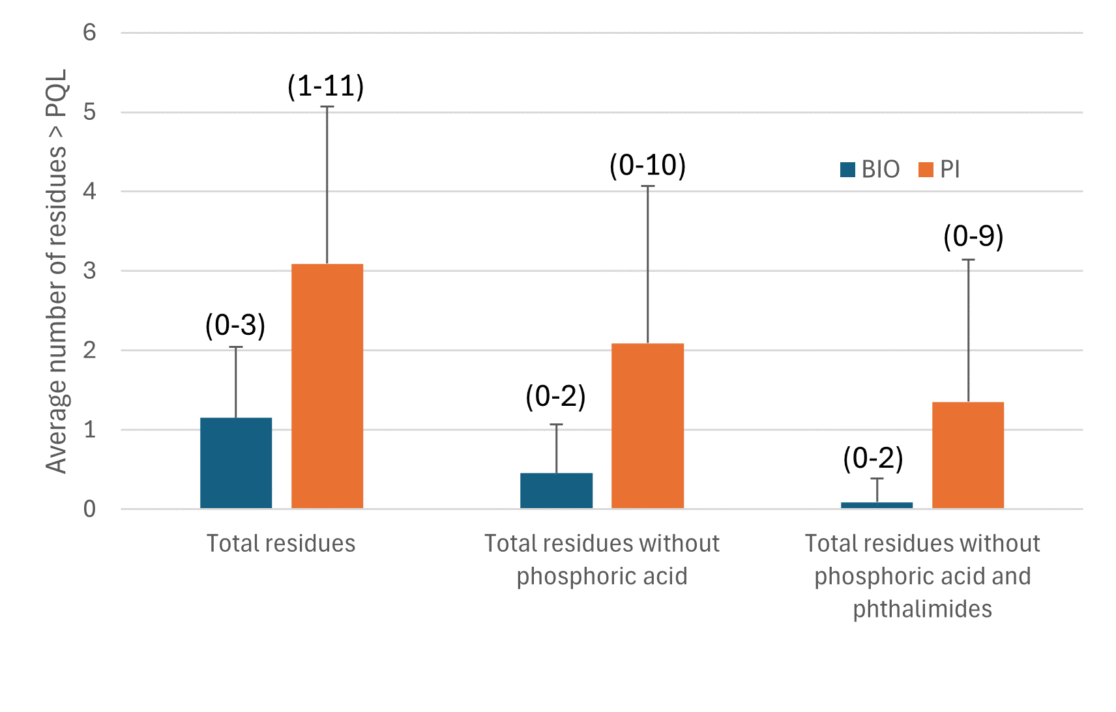
The average number of residues ranged between 1.2 for organic wines and 3.1 for IP wines (Fig. 1). The average values decrease considerably when phosphoric acid and phthalimides whose provenance is not necessarily associated with plant-protection product treatments are left out of the equation, resulting in organic wines with virtually no residues and IP wines with a maximum average of 1.4 residues.
Fungicides: the crux of the issue
The great majority of residues were fungicides or their metabolites. Among the active substances identified are seven anti-botrytis active substances (fenhexamid, boscalid, cyprodinil, fludioxonil, fenpyrazamine, carbendazim and thiophanate-methyl), seven anti-mildew active substances (fosetyl-Al, iprovalicarb, mandipropamid, metalaxyl, dimethomorph, azoxystrobin and ametoctradin) and four anti-powdery-mildew active substances (fenpropidin, fluxapyroxad, fluopyram and spiroxamine). No traces of acaricides were detected in the samples analysed; 98% of the wines contained no traces of insecticides above the PQL and 99.3% contained no herbicide residues.
Conclusions
- The findings show that 99.6% of the analysed Swiss wines comply with the legislation and that the residues identified are far below the maximum authorised legal limits.
- The number of residues is lower in organically produced wines than in the wines from integrated production.
- Fungicides are the most frequently detected in wines whereas acaricides, insecticides and herbicides were only very rarely detected.
Bibliographical reference
Quels résidus dans les vins suisses? Bilan 2019–2021 de la plate-forme VITISWISS.