How Stable Will Future Crop Yields Be in Switzerland?
Photo: Gabriela Brändle,
Agroscope
Stable yields in plant production are crucial for farm profitability and food security. Model simulations show that the yield stability of many summer crops could decline substantially due to climate change, while winter crops are significantly less affected.
Unfavourable weather conditions, particularly drought and heat, have negative effects on plant growth. With climate change, adverse situations occur more frequently. The result is increasing fluctuations in harvest yields. This has implications for the country’s food security and the income of farmers.
Switzerland’s degree of self-sufficiency depends on stable yields
Switzerland’s degree of self-sufficiency in plant products currently stands at around 40%. Population growth, coupled with the necessity, as formulated in the climate and food strategy, of gearing diet more closely to the food pyramid, requires plant production to be increased. At the same time, increasing the utilised agricultural area is scarcely feasible. To be able to ensure a minimum degree of self-sufficiency in future, including as regards plant-product production, both high yields and high yield stability are of fundamental importance.
Future harvest yields modelled on the basis of Swiss climate scenarios
This study simulates harvest yields for a crop rotation with winter wheat, winter barley, maize, oilseed rape, sugar beet and potatoes, soybean, and temporary leys as a catch crop, using a plant-growth model for the present-day climate and the period around 2060. The simulations are based on the climate scenarios provided by the National Centre for Climate Services (NCCS). The growing regions of the Western Plateau, Central Plateau, Eastern Plateau and Eastern Jura were taken into account.
Different effects on winter and summer crops
The effects of climate change on plant growth differ between summer and winter crops. Higher spring temperatures, earlier onset of the growing season and better water availability have a positive impact on winter crop yields. Winter crops also benefit significantly from increased CO2 concentrations in the atmosphere. By contrast, when cultivated without the use of irrigation, maize, sugar beet and potatoes are affected by the decrease in rainfall and the rise in evaporation rates in the summer. Hence, annual fluctuations in summer rainfall lead to a noticeable decrease in yield stability in the case of maize, sugar beet, potatoes and soybean, even when the positive impacts of increased CO2 concentrations in the atmosphere are taken into account.
Decreasing yield stability highest in the Central Plateau
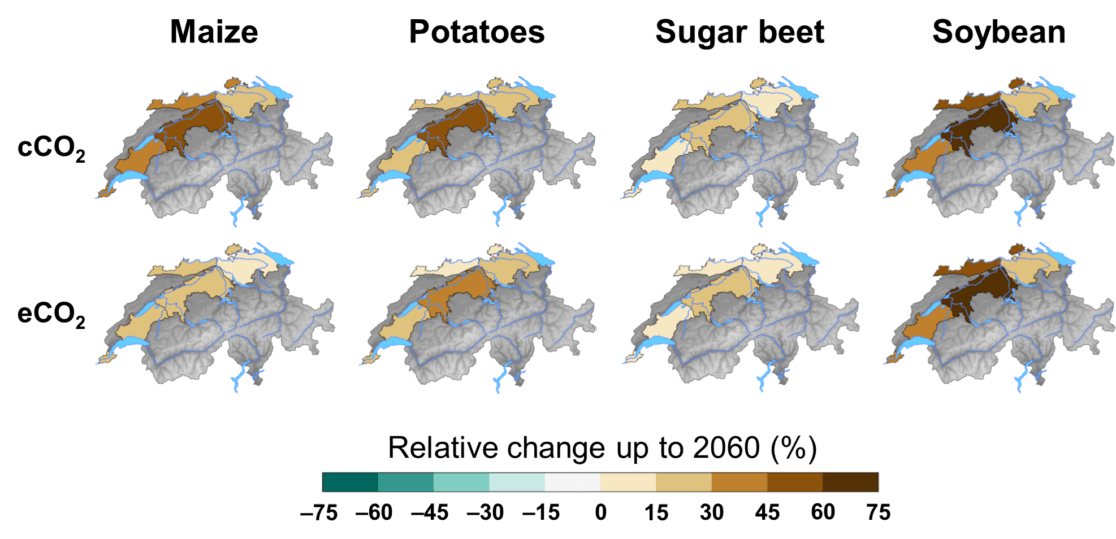
Switzerland’s Central Plateau is particularly hard-hit by this decline. According to simulation results, without taking into account the positive effects of increased CO2 concentrations in the atmosphere, yield fluctuations in this region will increase by over 60% for soybean, over 50% for maize, by 40% for potatoes and by 25% for sugar beet (Fig. 1). Although the increase in variability will be mitigated by the influence of the rising CO₂ content, it will still stand at over 20%. These results are an important basis for further analyses on the profitability of cultivation systems, the need to adapt insurance strategies and the guaranteeing of food security under future climate conditions.
Conclusions
- In future, the decline and greater annual range of variation in summer rainfall caused by climate change will lead to a noticeable decline in the yield stability of summer crops.
- Model simulations show that the Swiss Central Plateau is the region that will be hardest hit by these changes.
- A lower decline in yield stability was simulated for winter cereals.
Bibliographical reference
Model projections indicate substantial decrease in yield stability for summer crops in Switzerland, but less so for winter crops.