Conserving Fodder Plants in situ: Challenges and Perspectives
Photo: Marco Odermatt, Vocational Training Centre for Nature and Nutrition in Agriculture, Lucerne
The biodiversity of grassland areas is a precious resource that must be preserved. The evaluation of the in situ conservation programme by farmers and experts has led to recommendations for its improvement.
Meadows and pastures account for a significant percentage of Switzerland’s agricultural land, while also being among the richest ecosystems in Europe. Various agro-environmental measures aim to preserve their diversity, but rarely within the same species (intraspecific diversity).
An innovative programme for intraspecific diversity
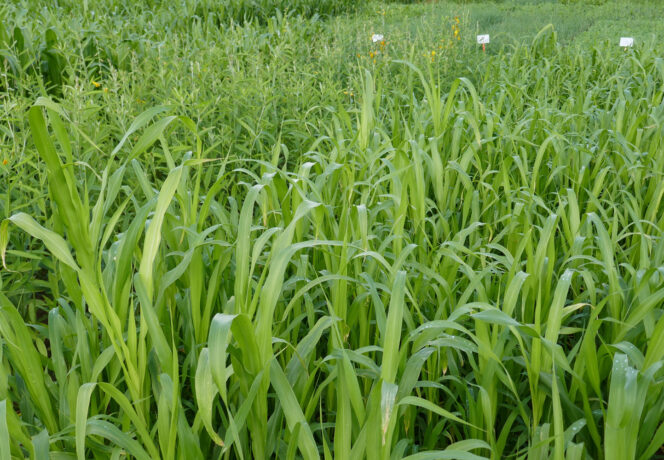
The in situ conservation programme for fodder areas was launched in 2023 with precisely this aim in mind: to preserve the intraspecific diversity of wild species that are related to or used as fodder plants (Figure 1).
An initial assessment of the programme by more than a thousand farmers provided insight into the types of farms that are more likely to participate in the programme and the motivations behind their participation. Larger, high-altitude farms that are part of certification schemes tend to be more likely to participate in the programme.
Initial findings and scope for improvement
In this article, five experts review the initial results of this evaluation to outline ways of improving the effectiveness and efficiency of the in situ programme and discuss the future of agrobiodiversity conservation on farms (Figure 2).
Conclusions
- The in situ programme helps to preserve the genetic diversity of fodder plants
- Its evaluation shows that it is well accepted, but there is room for improvement
- In situ areas are particularly important in responding to climate change.
Bibliographical reference
Le programme de conservation in situ des plantes fourragères: bilan et perspectives.