Valais Rye Bread AOP Proves Impressively Diverse
Diversity of Valais rye bread AOP
Hans-Peter Bachmann, Agroscope
The Valais rye bread AOP project is a project-specific field study with a clearly defined, geographic and legal context (AOP/PDO). The aim is to describe the authenticity and quality of this traditional sourdough.
To characterise the authenticity of Valais rye bread AOP, we analysed flour, dough samples and loaves (both fresh and after one week’s storage) from 21 representative bakeries. In addition, we identified possible factors influencing the quality and diversity of Valais rye bread AOP based on the results.
High bacterial diversity, low yeast diversity
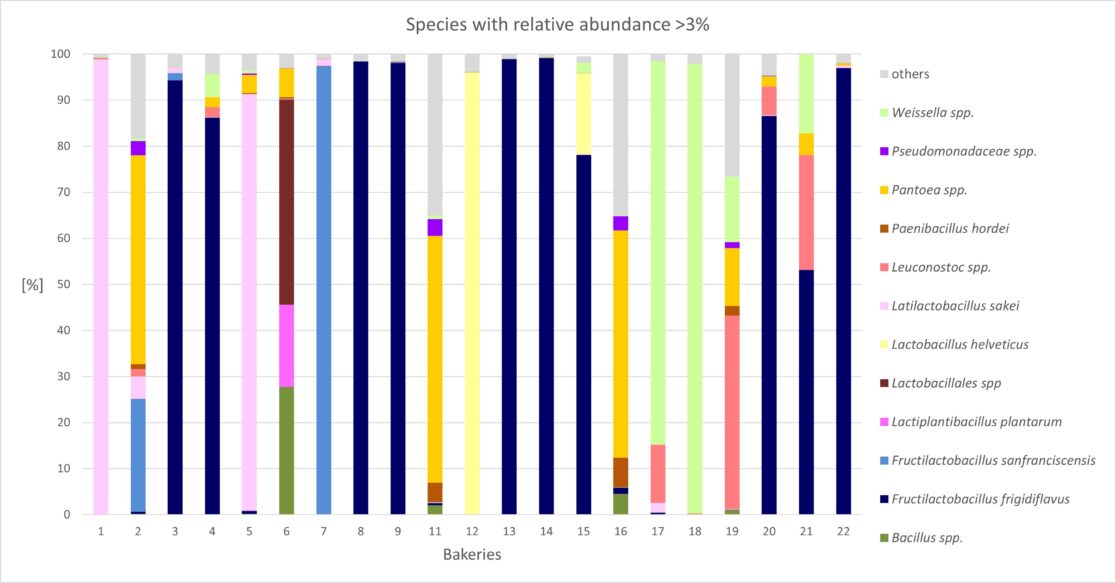
Metagenomic analysis of the dough samples showed low yeast biodiversity and high bacterial biodiversity. The typical sourdough bacterium Fructilactobacillus sanfranciscensis had the highest abundance in one dough only. Fructilactobacillus frigidiflavus, a novel species described in 2025, was dominant in 10 of the 21 doughs. Different species of other lactic acid bacteria dominated in seven doughs. Gram-negative bacteria had the highest relative abundance in three doughs. This indicates that these may have been ‘young’ sourdoughs that had undergone only a few feeds. As for yeasts, only three doughs were found to contain significant quantities of species other than the brewer’s yeast Saccharomyces cerevisiae.
Proportion of wheat flour has the greatest impact
This study found the proportion of wheat flour to be the most significant factor influencing the quality and diversity of Valais rye bread AOP. It is important to note that the bakeries which used 100% rye flour also more closely correspond to the original Valais rye bread AOP, which was designed primarily to have a long shelf life. The loaves made from pure rye flour were on average more sour and slightly saltier than the loaves with added wheat flour. They were also slightly more aromatic, fruity, fermented flavour and a little less cereal-like. When rye flour alone was used, fermentation was more intense, more fermentation products were produced, and the pH was lower.
Most of the Valais rye breads AOP were only slightly sour. Sourness was determined by the lactic acid content, with acetic acid playing only a minor role.
Statistical correlations hard to find
Many bakers do not follow a strict recipe when making the Valais rye breads AOP. Instead, they rely on their sensory observations and years of experience to guide the process. This greatly limited options for the researchers to identify statistical correlations between the production parameters and the characteristics of the breads.
From the isolated strains of lactic acid bacteria, it was possible to produce a biodiverse sourdough culture which significantly increased the authenticity of the Valais rye bread AOP and its connection to the terroir. A minimum level of lactic acid boosted the flavour profile of the Valais rye bread AOP without increasing sourness.
Conclusions
- The dough samples had high bacterial and low yeast diversity. The new species described in 2025 (F. frigidiflavus) was found in almost half the samples.
- The proportion of wheat was found to have the greatest influence on quality and aroma profile.
- Pure rye breads were more sour, more aromatic and had more fermented flavour than mixed breads.
- Sourness was largely determined by lactic acid, not acetic acid.
- Inconsistent manufacturing processes impeded statistical analysis.
- A biodiverse sourdough culture increased authenticity.
Bibliographical reference
Authentizität von Walliser Roggenbrot AOP.