Fabric Wrap Optimises Cheese Ripening
Photo: Hans-Peter Bachmann,
Agroscope
Smear-ripened cheeses often develop quality problems such as odours and stickiness in the pre-packing stage. A new ripening method which involves wrapping the cheese in biodegradable fabric offers a solution. Trials conducted in commercial cheese dairies have confirmed this.
Smear-ripened cheeses account for around half of Swiss cheese production. Their typical orangey brown rind is produced by a microbiota of yeasts and bacteria which make a significant contribution to the flavour and texture of the cheese and protect against undesirable microorganisms. Commercial dairies often pack these cheeses in airtight packaging. This kills off the aerobic microbiota, enabling undesirable organisms to multiply. As a result, the cheeses develop off-odours and sticky surfaces. To prevent this quality loss, the smear is usually removed before packing – an extra step which impairs the typical appearance of the cheese.
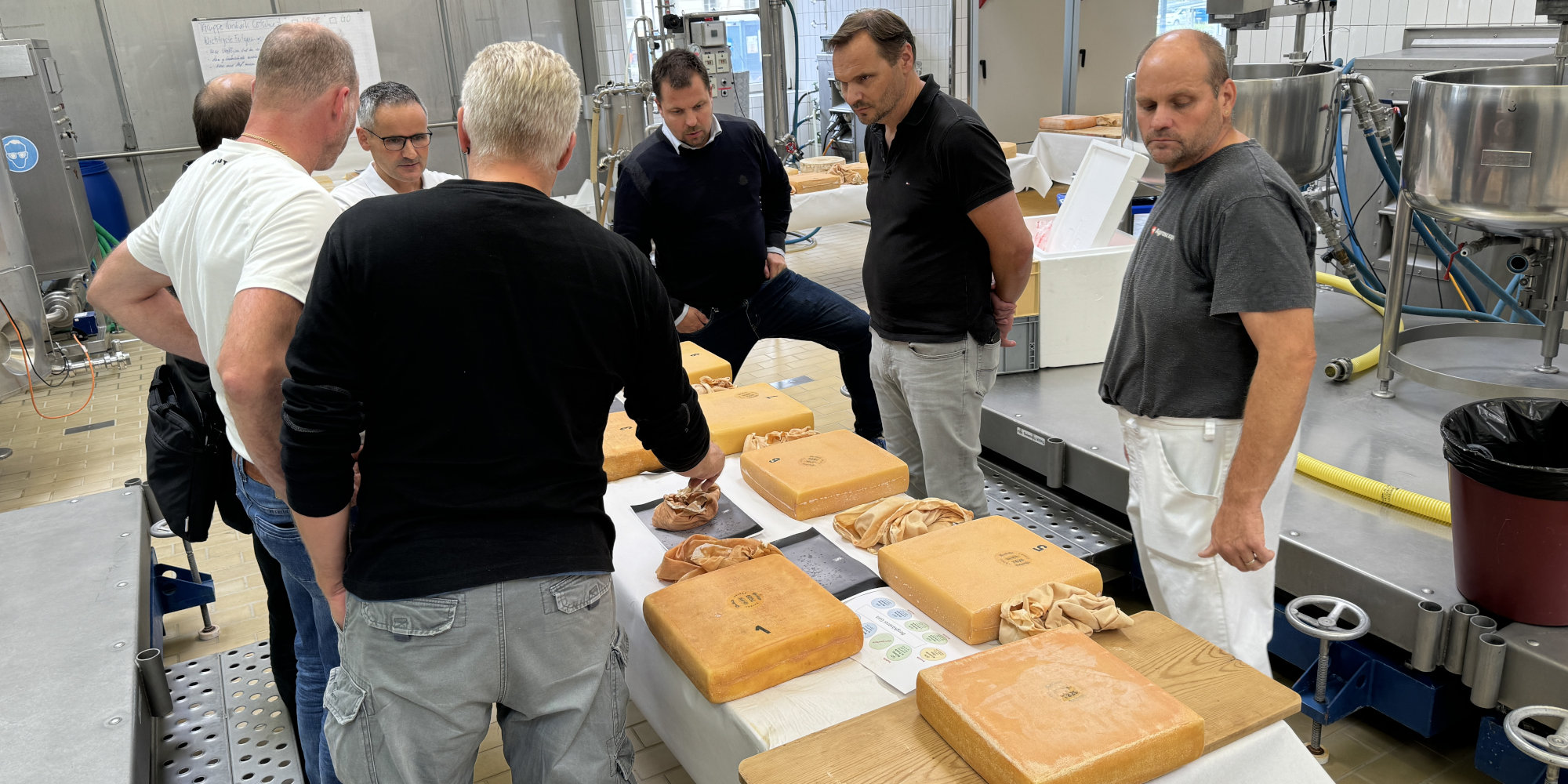
The new ripening method enables work processes to be optimised. The cheeses are wrapped in a biodegradable fabric immediately after brining. The microbiota on the cheese surface then grows on the fabric, which can simply be removed at the end of the ripening process. A small part of the microbiota remains on the cheese, giving it its distinctive orangey brown colour.

Optimised smear ripening with measurable quality benefits
The new process offers several interesting advantages as it requires considerably less effort than traditional smear ripening. The cheeses lose less water during ripening, which speeds up the ripening process and produces a thinner rind, a more intense flavour and a softer texture. After ripening, the smear and the fabric can simply be removed. Cheeses ripened with this method do not produce an off-odour or become sticky in the pre-packing. Furthermore, Raclette cheese has improved melting properties.
The method has been registered with the European Patent Office and the patent was granted in early 2023.

High levels of expertise in modern cheese ripening
The new ripening process requires at least as much specialist knowledge as traditional smear ripening. The tiniest changes must be detected at the earliest opportunity and corresponding adjustments made to the climate or regime. The fabric wraps must also meet specific requirements regarding elasticity, food safety and biodegradability. Conflicts of interest – especially between material properties and the migration of undesirable substances – have been technically addressed. As with traditional smear ripening, there is no one recipe for the new method that works for all types of cheese and in all maturing cellars.
Summary
- The new ripening method has the potential to improve the quality of smear-ripened cheese and make production processes more efficient. However, its implementation requires specialist knowledge as well as adjustments to operating processes.
- The method is being introduced in artisanal cheese production using prefabricated fabric bags. Agroscope recommends a pragmatic approach:
- In the first phase, only a small number of cheeses are wrapped in fabric and then ripened in the same way as the un-wrapped cheeses.
- In the second phase, mechanical brushing can be gradually reduced and the number of cheeses gradually increased.
- In the third phase, the new ripening method is implemented in full.
The insights gained in this initial introduction may be helpful to industrial cheese producers.
- The method supplements existing practices and offers various operational advantages, depending on the starting position.
- The new method also offers promising potential for the production of plant-based foods with new sensory characteristics or a higher dry matter.
Bibliographical reference
Optimierte Käsereifung dank Textilhülle.