A Table-Based Tool Makes Calculating the Nitrogen Requirement of Arable Crops Easier
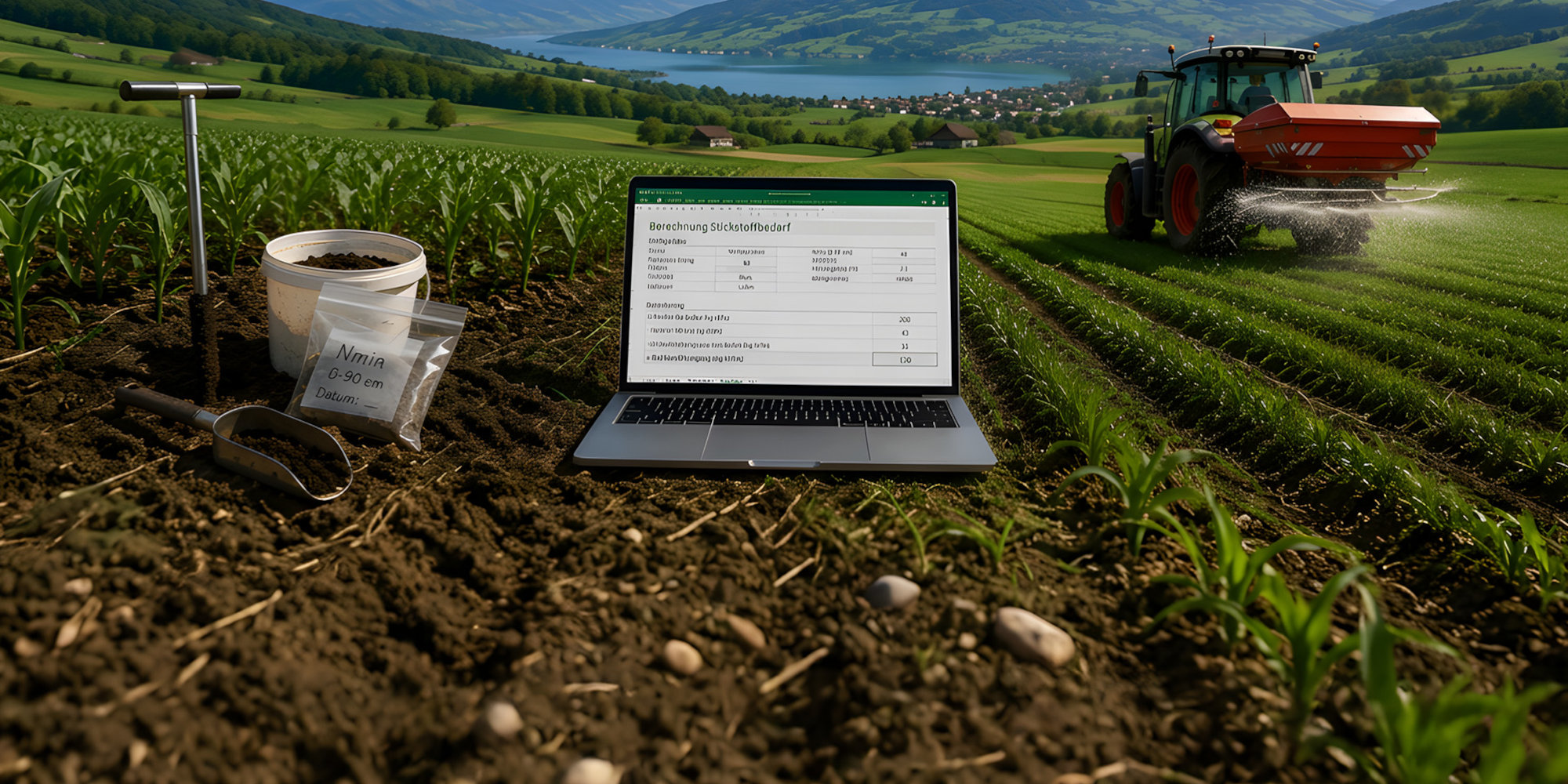
Photo: Open AI, ChatGPT, 2026
Nitrate in the groundwater poses a challenge on intensive arable farmland. A simple new table-based tool helps extension services in the Niederbipp-Gäu-Olten Nitrate Project calculate the nitrogen requirement of arable crops with greater precision and ease.
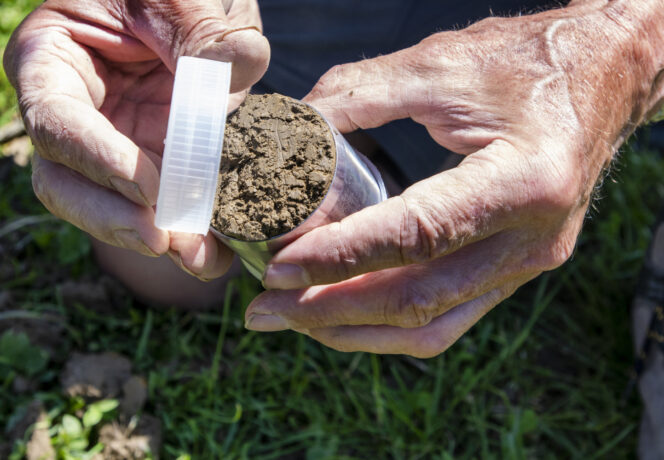
In Switzerland, nitrogen fertilisation in arable production is mostly based on standard values and scientifically substantiated correction factors. To date, however, these have not explicitly considered how much plant-available nitrogen is actually present in the soil when the fertiliser is applied. The ‘Nmin-based fertilisation in arable crops’ method makes such a consideration possible, factoring in the plant-available mineral nitrogen (Nmin) in the soil in the form of nitrate and ammonium at the time when the fertilisation measure is implemented. The Nmin method is based on the actual Nmin content in three soil layers (0–30, 30−60, 60−90 cm depth) and adapts the fertiliser inputs to the site in question.
Table-based tool to support extension services
Needs-based nitrogen fertilisation is particularly important in areas where there is nitrate contamination of groundwater and drinking water. For this reason, the Federal Government promotes management measures to reduce water pollution through so-called ‘nitrate projects’. Through the ‘Niederbipp-Gäu-Olten’ (NGO) Nitrate Project (Cantons of Solothurn and Bern) and the accompanying ‘CriticalN’ Project, Agroscope, TerrAquat, the Wallierhof Education Centre and the Inforama Competence Centre have developed an Table-based tool for simplifying Nmin-fertilisation for the extension services.
The tool calculates the fertiliser requirement by linking the analysis data from the soil samples taken with additional information such as crop type, yield expectations and soil properties as well as preceding crops and catch crops, using the nutrient requirement of the crops according to the Principles of Agricultural Crop Fertilisation in Switzerland (GRUD/PRIF) as a basis. The crops ‘winter wheat’, ‘winter barley’, ‘winter oilseed rape’, ‘grain maize’, ‘silage maize’ and ‘sugar beet’ are considered at present.
The tool comprises four steps:
- Data input: Farm, soil and crop data, data on preceding crops, catch crops, and information on previously applied organic and mineral fertilisers.
- Calculating the available nitrogen in the soil (Nmin): Importing the laboratory results for the soil samples and converting these according to the Agroscope reference method.
- Calculating the nitrogen requirement based on the Nmin values, crop-specific nutrient requirements and various correction factors for e.g. yield expectations, soil properties or impacts of the preceding crop.
- Issuing the fertilisation recommendation in the form of a clear recommendation for extension services and farms.
Specific adjustments for the NGO Nitrate Project
The tool contains project-specific methodological refinements, for example, a 10% higher crediting of nitrogen from organic fertilisers, a different date for the Nmin sampling in the cereal crop as well as surcharges and discounts based on parcel-specific operations such as yield expectations, soil organic matter and the preceding crop. Furthermore, the tool automatically limits the fertiliser recommendation to the Suisse-Bilanz standard fertilisation values for the crop in question, as this is stipulated for farms in nitrate projects according to the Water Protection Act. This is why the tool is currently only intended for the NGO Nitrate Project, but can be refined for other nitrate or digitalisation projects.
Suggestions for refining the Nmin method
The development of the tool in the project has highlighted further requirements for optimising the application of the methodology: standardisation of sampling, storage, transport and analytics should be better to ensure data quality. More-precise data on the nutrient requirements of additional crops and varieties would also help the needs-based fertilisation according to Nmin to be calculated more accurately.
Conclusions
- Fertilisation according to the Nmin method factors in the plant-available nitrogen, thereby enabling more-precise fertilisation and lower nitrogen losses than the currently used estimation method.
- The new Table tool simplifies the calculation of the fertilisation recommendation according to the Nmin method by automatically providing a clear recommendation for extension services and farms from laboratory and farm data.
- Due in particular to the specifically adapted correction factors, the Table tool is currently only suitable for the Niederbipp-Gäu-Olten (NGO) Nitrate Project, but can be refined for other nitrate and digitalisation projects.
- The Nmin method could be optimised for the nutrient requirements of additional crops and varieties through the standardisation of sampling, storage, transport and analytics and through more-precise data.
Bibliographical reference
Nmin-basierte Stickstoffdüngung im Ackerbau im Nitratprojekt Niederbipp-Gäu-Olten.