Duckweed: a Future Feed Ingredient for Closing Nitrogen Cycles?
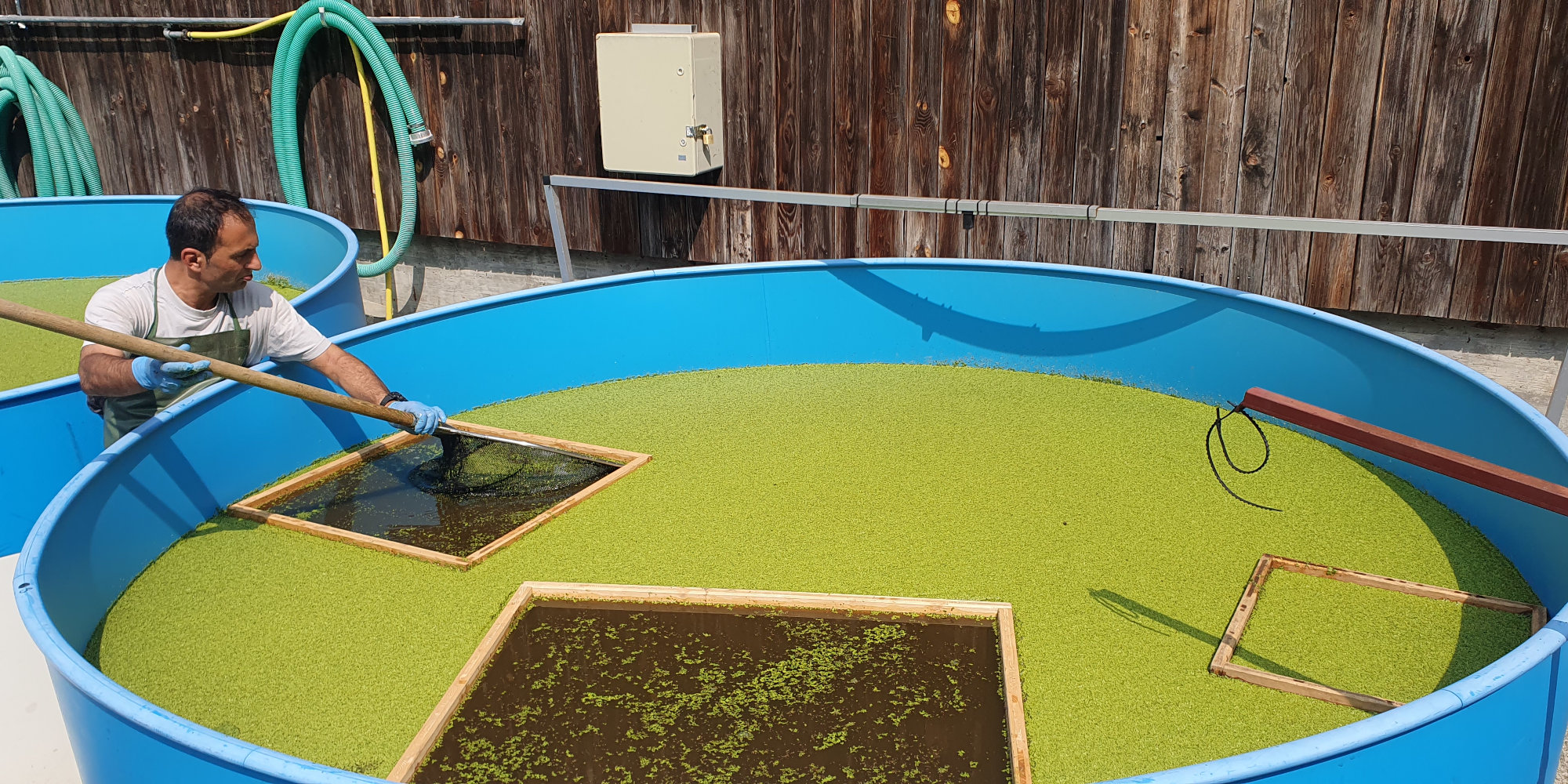
Photo: Jens Wohlfahrt,
FiBL
Duckweed can efficiently produce protein-rich biomass on nutrient-rich waters, such as wastewater or liquid farmyard manure, while simultaneously binding nitrogen and phosphorus. This presents potential for modern circular economy systems.
In recent years, numerous trials on various scales have been conducted at the Research Institute of Organic Agriculture – FiBL in Frick (CH) to evaluate and develop the possibilities and challenges to produce duckweed on diluted farmyard manure. As duckweed efficiently absorbs soluble nitrogen and phosphorus compounds from the nutrient medium and forms protein-rich biomass, it could serve as a link in a short on-farm N cycle. Nitrogen surpluses from farmyard manure could be depleted and, at the same time, an alternative protein source for animal feed could be produced.
Optimizing conditions for duckweed production
The basic feasibility has been demonstrated and optimised on various experimental scales. At optimal dilutions of manure (eight parts water, one part manure) and ammonium N concentrations (around 20 mg/L), nitrogen and phosphorus compounds from the medium are efficiently converted into plant material with around 30% crude protein in the dry matter. In this way, around 180 kg DM per 100 m² per year could be produced. Converted to one hectare, this would be a yield of around six tonnes of crude protein per year, albeit a theoretical value.
Ecological assessment of the practice
However, as there were also nitrogen losses, the measurement and calculation of ammonia and nitrous oxide emissions is still a key prerequisite for the overall ecological classification of such a process. A study on this is currently being evaluated at FiBL.
Processing and use in animal nutrition
Another challenge lies in the processing of the biomass, especially drying and hygienisation. It has been shown that the hygienic quality was generally, but not always, very high and that the problem can be greatly reduced, especially by storing the manure appropriately before using it as a medium. In addition to drying, ensiling the duckweed is also an option for processing and has been carried out with good results on a laboratory scale.
Fish feeding trials showed its general suitability as a fishmeal substitute, but also its limitations. Poultry feeding trials are planned at FiBL soon.
Conclusion
- The production of duckweed on liquid farmyard manure substrates offers an innovative approach to closing nutrient cycles and an alternative protein source for feeding fish, and likely also poultry or pigs.
- Before the process can be truly implemented in practice, several steps still need to be optimized and challenges – particularly in the areas of hygiene and processing – need to be addressed.
- The results of the FiBL trials suggest that it is worthwhile to pursue this path further. An important next step is the establishment of pilot plants on private farms.
Bibliographical reference
Duckweed: a Future Feed Ingredient for Closing Nitrogen Cycles?