Agri-photovoltaics in the Canton of Zurich: Utilising Economic Potential, Managing Risks
Photo: Kaspar Kluth,
ZHAW
Agri-photovoltaics in the Canton of Zurich: Utilising Economic Potential, Managing Risks
Agri-photovoltaics can combine agriculture and electricity production in the canton of Zurich in a meaningful way. The feasibility study shows economic potential – but with site-dependent uncertainties and high planning and approval requirements.
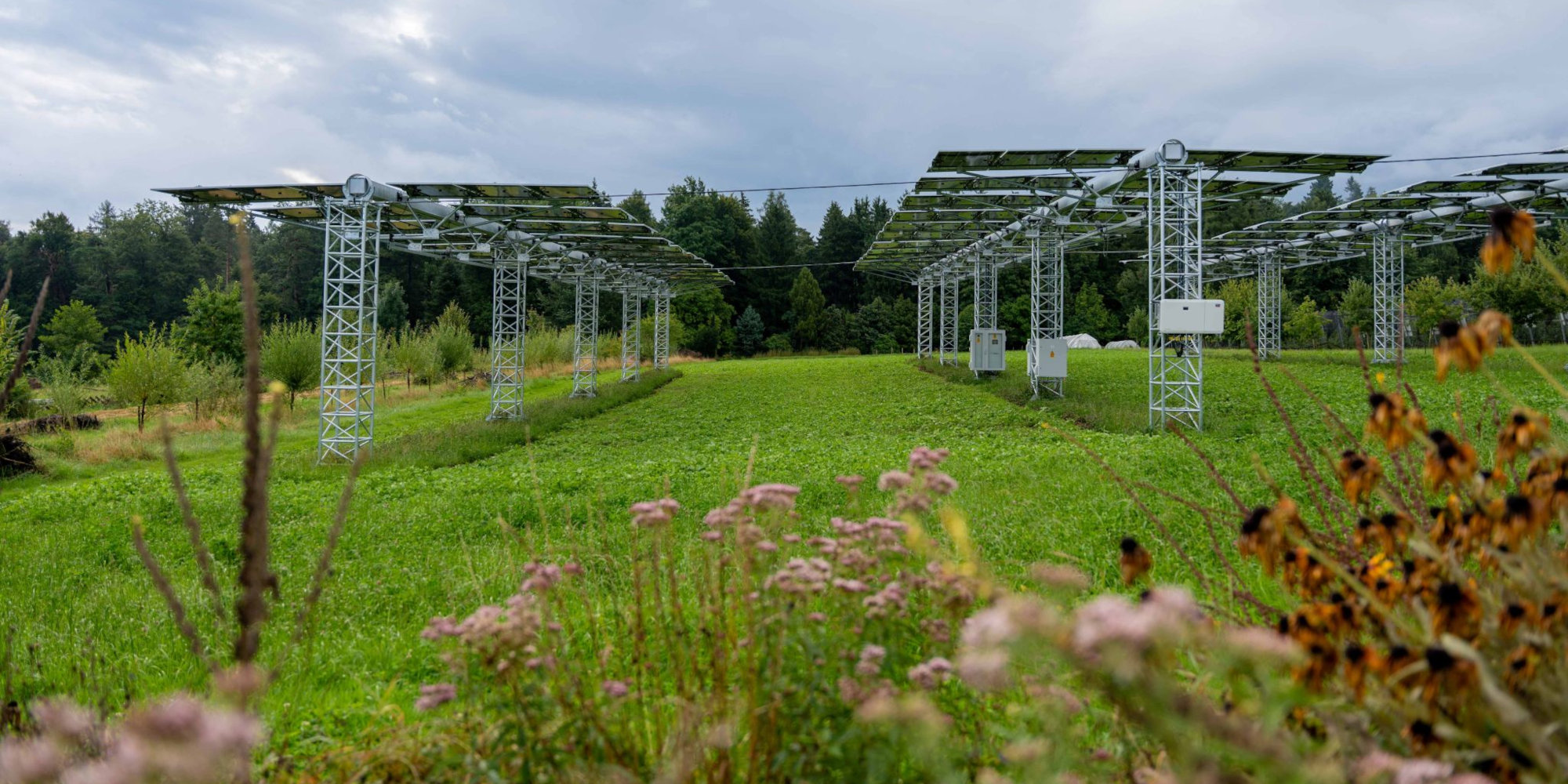
The energy transition and the pressure on agricultural land require innovative solutions. Agri-photovoltaics enable the simultaneous use of land for agriculture and energy production. The feasibility study as part of the ‘Pilotprojekte Agri-Photovoltaik im Kanton Zürich’ examined eight sites for agri-photovoltaic projects in the canton of Zurich in terms of agronomic and economic aspects and provides important insights for policy and practice.
Generally feasible – some high winter electricity production possible
The analysis shows that agri-photovoltaic systems are generally feasible and in some cases offer attractive investment opportunities. However, the economic viability varies greatly depending on the type of system, size and site conditions. There are particularly robust cost estimates for vertical systems, while there are uncertainties for more complex tracking systems.
The specific electricity yields of agri-photovoltaic systems are generally between 1100 and 1470 kWh/kWp per year, depending on the system type, and are thus higher than the yields of conventional rooftop PV systems. There are differences, in particular, in seasonal production:
- 2-axis and 1-axis tracking systems achieve the highest absolute electricity yields and particularly high winter electricity production.
- Vertical systems have a lower total production but achieve the highest winter electricity share.
- With fixed systems, the annual yield is slightly higher than with vertical systems, but the winter electricity share is lower.
These differences are crucial for economic viability, as winter electricity is in particularly high demand in the Swiss energy system.
Self-consumption models and local electricity communities (LEGs) can significantly improve economic viability but are not feasible at all sites. Implementation also requires complex coordination between agriculture, spatial planning, grid operators and investors.
No existing knowledge – challenges remain
Identifying suitable areas is time-consuming and involves uncertainties. The approval procedures are complex and legally unclear in some respects, particularly with regard to the requirements of the Spatial Planning Act. In addition, there is a lack of practical experience, particularly in the application of agri-photovoltaic systems to arable and grassland areas.
From an agricultural perspective, agri-photovoltaic systems offer opportunities such as protection from extreme weather events or microclimatic benefits, but they require specific expertise and careful planning. At the same time, soil load and agricultural productivity must be taken into account.
Economic potential with significant variations
The agri-photovoltaic systems examined show considerable differences depending on the location and type of system. Investment costs range from CHF 1,100 to CHF 2,500/kWp, including grid connection. In an extreme example, the investment costs amounted to CHF 4,000/kWp. Costs of over CHF 1,700/kWp are mainly due to small and/or complex systems. The electricity generation costs are mostly between CHF 0.045 and CHF 0.075/kWh after subsidies or between CHF 0.075 and CHF 0.12/kWh before subsidies. This means that agri-photovoltaics can supply electricity at a lower cost than other new electricity generation technologies.
Best-case returns for agricultural businesses
The study shows that the most economically attractive variants have a potential financial return of between CHF 8,000 and CHF 16,000/ha/year. Over an assumed 25-year duration, this corresponds to a net market value of between CHF 200,000 and CHF 400,000/ha. In contrast, the external financing models examined offer rental income of between CHF 10 and CHF 20/kWp, which corresponds to between CHF 2,500 and CHF 10,000/ha/year or between CHF 62,500 and CHF 250,000/ha over 25 years, depending on the installed capacity. This means that the equity investment can generate significantly higher returns, but it requires capital and a willingness to take risks.
Conclusion and recommendations
- Expand targeted promotion and advice: Agri-photovoltaic projects are complex and require interdisciplinary expertise. Advisory services can reduce entry barriers and increase investment security.
- Create legal clarity: Uniform and transparent approval criteria are crucial to ensure planning security for agricultural businesses and investors. Legal frameworks, particularly in the area of land law, are crucial in this regard.
- Promote pilot projects and reference systems: The first successful projects are essential for gaining practical experience, building trust and unlocking scaling potential.
- Addressing market and price risks: Policy instruments should help to reduce uncertainties in electricity prices and remuneration and allow for long-term investments.
Bibliographical reference
Abschlussbericht - Pilotprojekte Agri-Photovoltaik im Kanton Zürich.