The Biological Clock at the Feeder: Feeding Rhythms in Pigs Are Strongly Shaped by Genetics
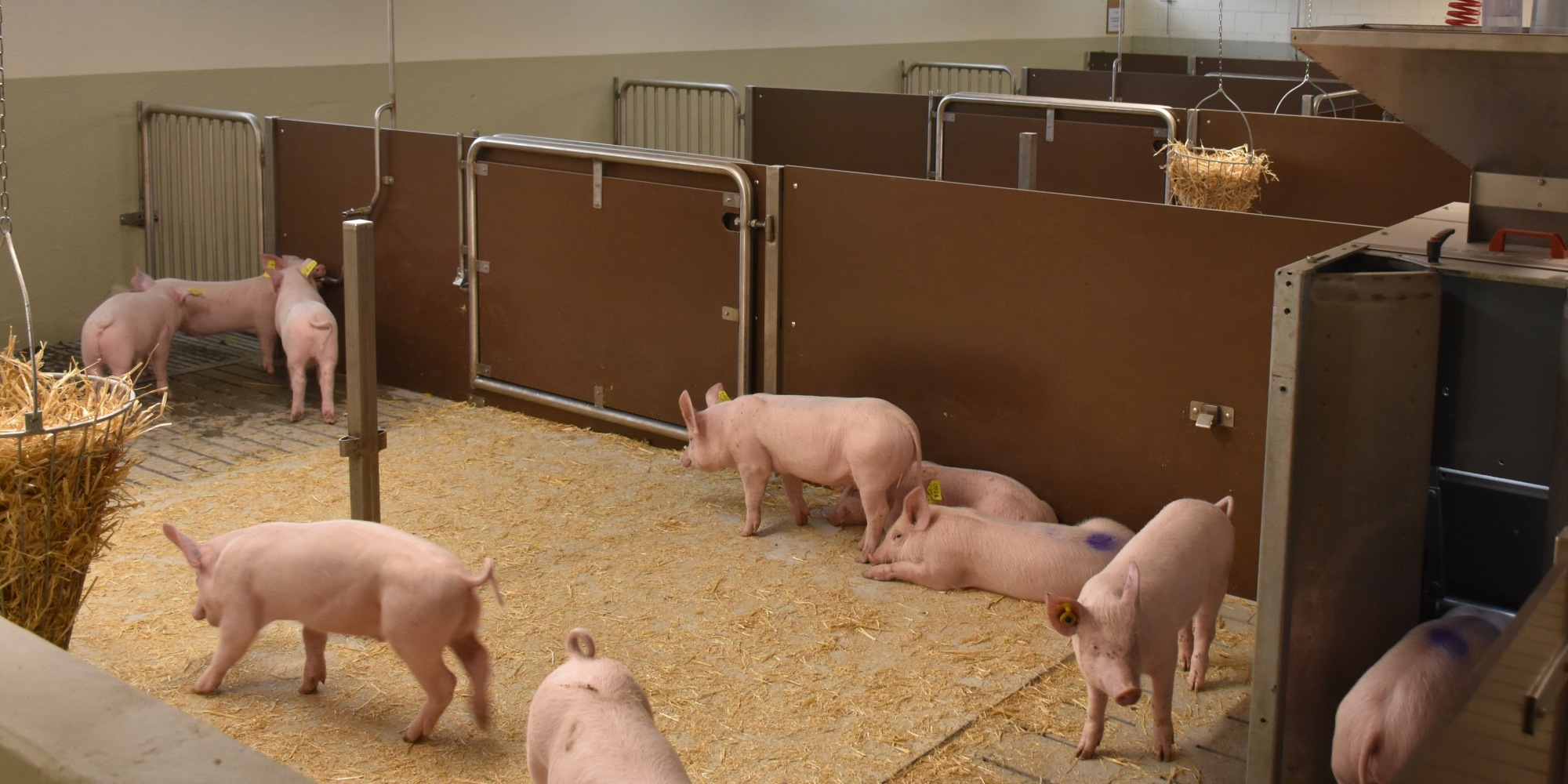
Photo: SUISAG
Pigs with regular daily feeding patterns use feed more efficiently. Researchers at ETH Zurich show that feeding rhythmicity is strongly influenced by genetics and could become a new trait for pig breeding programmes.
Automated feeding stations provide detailed information on how much a pig eats and when it eats. Daily averages, such as daily feed intake, are regularly extracted from these data to evaluate animal performance and health. However, the timing of feed intake, which has an impact on metabolism and health, is barely considered. We therefore investigated whether the timing of feed intake itself contains useful information.
We used 40.5 million feeding records to quantify the proportion of days on which a clear, approximately 24-hour feeding pattern is detected for 18,651 Swiss Landrace and Swiss Large White pigs. This trait describes the circadian feeding rhythmicity: how consistently pigs eat from day to day under farm conditions.
Feeding rhythms differ strongly between pigs
Some pigs showed a pronounced circadian feeding rhythm on nearly every day, while others rarely did. Some followed their feeding schedule with Swiss-watch precision, while others varied much more from day to day. Females were more rhythmic than males, and rhythmicity increased with age.
More importantly, 53 to 57% of the observed variation in feeding rhythmicity was attributable to genetic differences. This is a high heritability for a behavioral trait and means that selection for feeding rhythmicity would be possible.
More rhythmic pigs ate less at night
Pigs with a strong feeding rhythm generally had very low feed intake during the night and improved feed efficiency. Previous research also showed that pigs fed only during the night deposited more fat than pigs fed during the day, highlighting that when pigs eat can matter for how efficiently nutrients are used. Therefore, feeding rhythmicity might be a promising trait to consider in breeding programs, as feeding is the largest production cost for pig farmers.
A major genomic region on chromosome 4
A genome-wide analysis identified a region on chromosome 4 that has a large impact on feeding rhythmicity in both breeds. This region explained up to 5% of the variation in feeding rhythmicity, which is a substantial effect for a complex behavioral trait. The region overlaps OPRK1 and NPBWR1, two genes known to be involved in the regulation of feeding behavior, reward and energy balance in other mammals. This makes the region a promising starting point for both understanding the biology of feeding rhythmicity and evaluating its potential use in breeding.
What could this mean in practice?
For breeding organisations already using automated feeding systems, feeding rhythmicity could be derived from data that are routinely collected. This means that the trait could be evaluated within existing breeding programmes without additional data collection. In the longer term, feeding rhythmicity could contribute to improved feed efficiency and lower production costs. Better feed efficiency could also help reduce resource use and the environmental footprint of pig production.
Conclusions
- Pigs differ in how consistently they follow a daily feeding pattern, and 53 to 57% of this variation is heritable.
- Stronger feeding rhythmicity is associated with less night-time feeding and better feed efficiency, without reduced growth.
- A region on chromosome 4, close to the genes OPRK1 and NPBWR1, contributes substantially to variation in this trait.
This study shows that the timing of feed intake may be an overlooked trait in pig breeding. Because regular feeding rhythms are both genetically influenced and associated with improved feed efficiency, they could become a valuable selection criterion in the future. Before routine implementation, however, the findings should be validated across additional populations and production systems to rule out unintended effects on other breeding goals.onclusions
Bibliographical reference
A large-effect locus on chromosome 4 underlies circadian feeding rhythmicity in pigs.