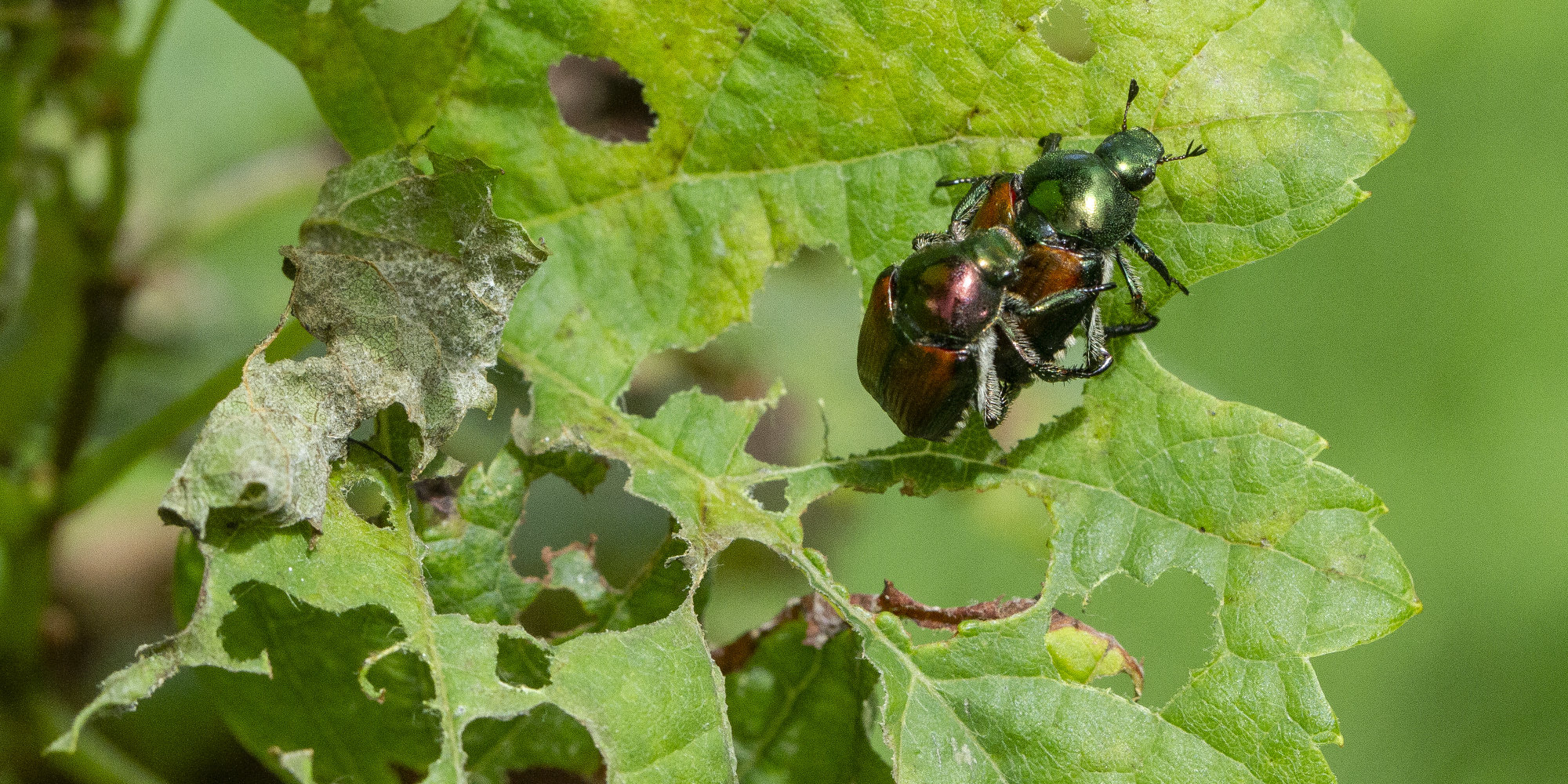
Japanese Beetles in Switzerland Have Italian and North American Roots
Photo: Christian Linder,
Agroscope
Genome analysis shows that Japanese beetle populations in Switzerland have different origins. This indicates several entry and dispersal routes – knowledge that can help develop targeted prevention and containment measures.
The Japanese beetle (P. japonica) is native to Japan. During the last century, it has spread from its homeland to become a major invasive pest in both North America and Europe. With advancing climate change, the Japanese beetle is expected to further expand its habitat into the northern regions of both continents, posing an increasing threat to agriculture and ecosystems.
The Japanese beetle infests many important crops
P. japonica feeds on over 400 plant species, including important crops such as grapevines, maize, soybean and fruit trees. Adult beetles cause substantial damage to the leaves, flowers and fruits of host plants.
Spread of the pest in Europe and Switzerland
The colonisation of Europe began in the Azores in the 1970s, followed by Italy in 2014 and Southern Switzerland (Ticino) in 2017. In 2023 a new population was identified north of the Alps near Zurich International Airport. Further individuals have also been found in the canton of Basel and in the Simplon area (Valais) close to the Italian border. In summer 2024, infestations were discovered in other parts of Switzerland, including another area in the canton of Valais, and isolated catches in the cantons of Aargau, Graubünden, Lucerne, Schaffhausen, Schwyz, Solothurn and Uri.
Using genome analysis to identify migration patterns
To understand the spread and origin of P. japonica in Switzerland, researchers at Agroscope and the University of Siena studied 42 individuals from infested areas in Switzerland.
They determined the genetic profiles of the Swiss individuals by analysing their DNA sequences. By comparing these with the profiles of individuals from Italy and North America, the researchers were able to identify the origin of the Swiss individuals. The Japanese beetle populations in Basel, Valais and Central Switzerland are related to the populations from Ticino/Northern Italy and probably arrived in Switzerland via the road or rail network. In contrast, the population near Zurich Airport was identified as a separate group more closely related to the North American population. These beetles are likely to have been imported by air.
Conclusions
- Genome analysis shows that Japanese beetle populations in Switzerland have different origins.
- The populations in Basel, Valais and Central Switzerland are closely related to individuals from Ticino/Northern Italy. They probably arrived in Switzerland via the road or rail network.
- In contrast, the population near Zurich Airport was identified as a separate group, and is likely to have been inadvertently introduced by plane.
- Understanding possible entry and dispersal routes is key to containing or even preventing their further spread.
- The control measures remain the same, whatever the origin.
Bibliographical reference
Population genomics identifies Italian and North American origins of Popillia japonica in Switzerland.