Räuschling Clone Breeding: Expansion of Genetic Diversity by Four New Clones
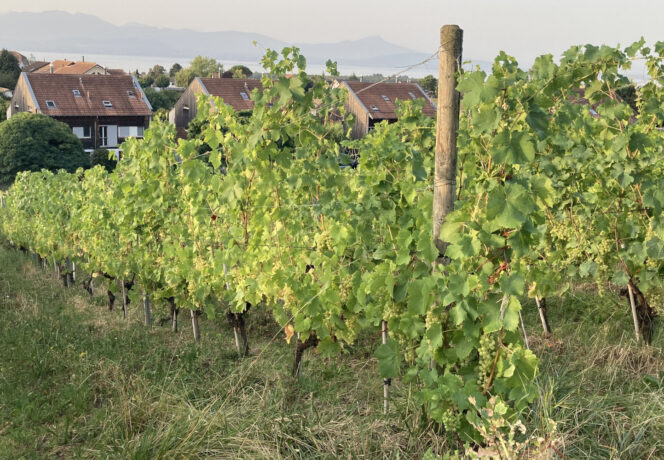
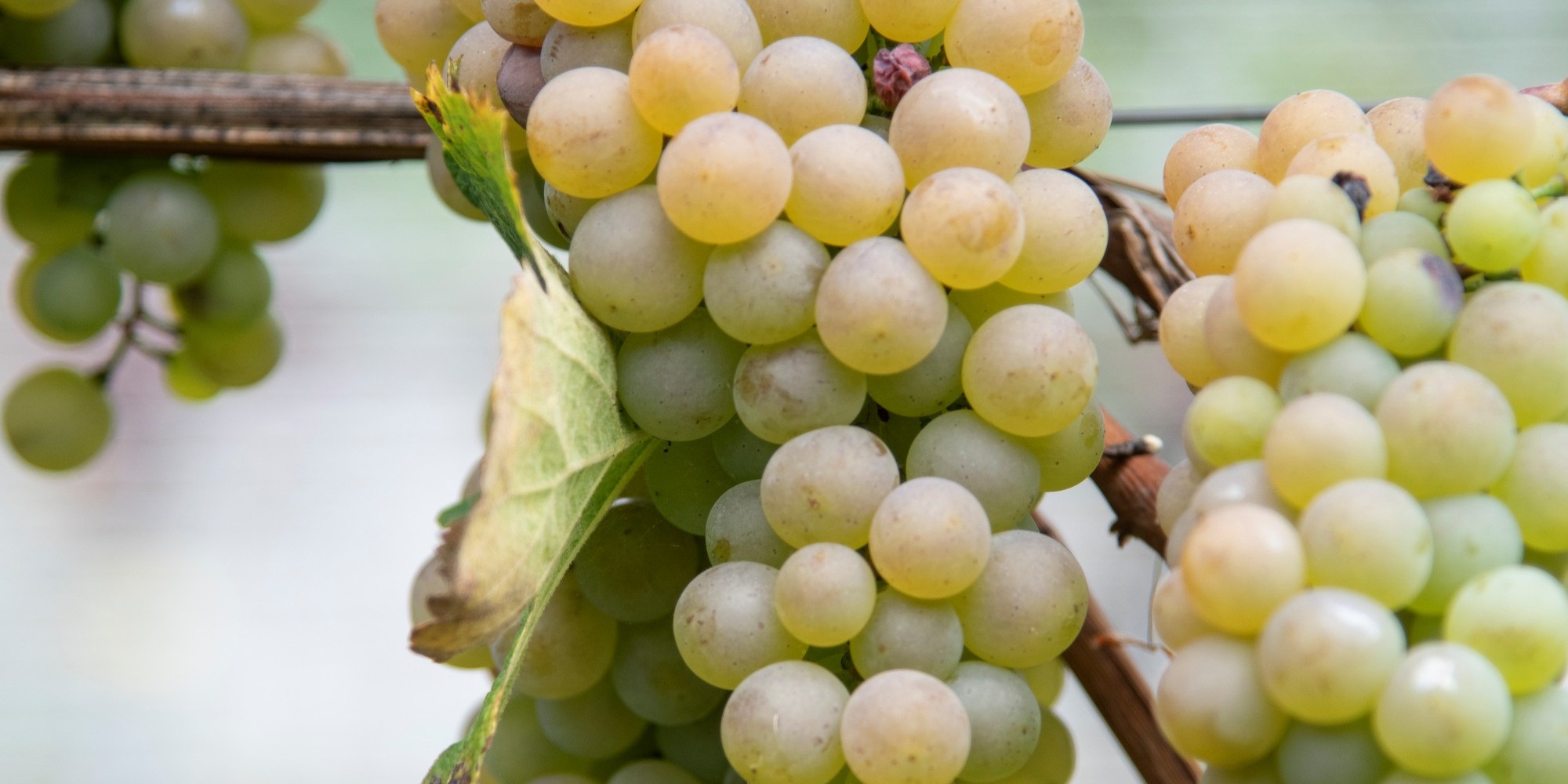
Photo: Prisca Koller,
Agroscope;
Räuschling Clone 42
Thanks to the selection of new clones, the ‘Räuschling’ grape variety has become more consistent in terms of cultivation and wine quality. Multi-year trials have shown that four new clones stabilise yield and quality and reduce the risk of both berry splitting and Botrytis (grey mould) infestation.
‘Räuschling’ is a white-wine grape variety of local historical importance, chiefly cultivated around Lake Zurich (2024: 28.3 ha, 72% in Zurich Canton). It is also considered challenging to grow: the berries tend to crack or split before the harvest, which favours Botrytis and increases the effort involved in selection and harvest.
Agroscope’s clone collection: the key to Räuschling’s genetic diversity
Since the 1970s, Agroscope has been carrying out a clone selection programme to improve yield security, disease resistance and grape quality. The current clone collection (20 genotypes) is the only one of this variety in the world, and is thus key for genetic diversity.
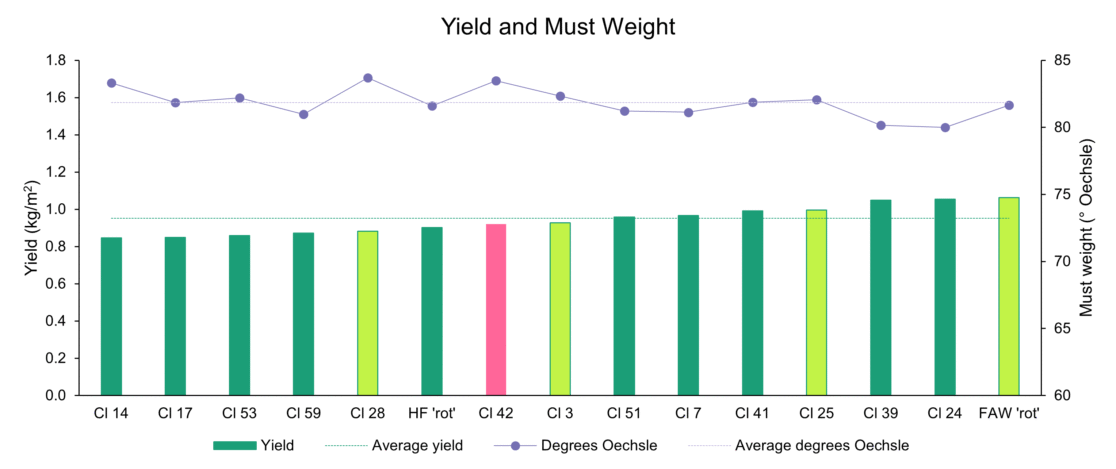
In Stäfa (Canton of Zurich), fifteen single-Guyot-pruned clones on an identical rootstock (3309C) were compared between 2015–2021, with Reference Clone 42 serving as the benchmark. Despite years characterised by extreme weather conditions (late frost/hail in 2017; wet summer in 2021) several clones reached the yield target of 1 kg/m². Must weights fluctuated within the narrow range of 80–84 °Oe (Fig. 1); acid buffering and pH (3.1) were similar across clones; oenological differences remained small.
The newly selected clones compared: differences in yield, Botrytis resistance and wine profile
- Clone 3: Very consistent yields, loose clusters, low susceptibility to splitting, lower tendency to Botrytis; top sensory rating; high formol index (yeast-available nitrogen).
- Clone 25: Highest yield potential together with relatively high sugar content; very loose clusters; in individual cases (2017/2019) more Botrytis, otherwise moderate susceptibility; sensory attributes were well rated.
- Clone 28: Higher-than-average sugar content, loose clusters, tendency towards less splitting/Botrytis; sensory attributes highlight fruity notes.
- FAW ‘rot’ (red-skinned): High yields with a relatively high must weight; little Botrytis despite compact clusters; fruity profile characteristic of the variety.
Mixed-clone plantings enhance resilience of ‘Räuschling’ grape variety
Important for practitioners: mixed plantings of several clones increase resilience, since characteristics complement each other depending on the vintage (e.g. high yields vs. susceptibility to splitting). This supports quality and yield, especially in years with precipitation before the harvest. Clones 3 and 25 are available; Clone 28 and FAW ‘rot’ are currently undergoing the approval process. The clone collection remains strategic for preserving diversity and for the ability to react adaptively to climate change.
Conclusions and Recommendation
- Clone selection: Suitable clones increase Räuschling’s consistency of both yield and quality, and reduce the risk of berry-splitting and Botrytis; in particular, Clone 28 and FAW ‘rot’ exhibit positive effects.
- System structure: Mixed planting of Clones 3, 25, 28 and FAW ‘rot’ can further increase resilience within a system.
Bibliographical reference
Räuschling-Klonzüchtung: Erweiterung der genetischen Vielfalt um vier neue Klone.