Carbon Footprints in Agriculture: Findings from Applied Research
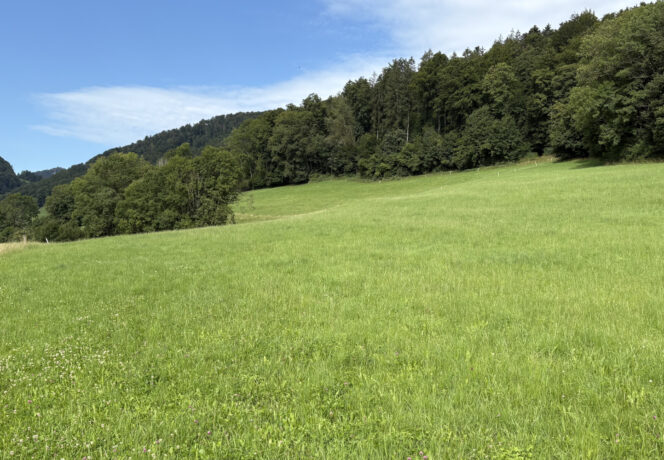
Photo: Gabriela Brändle
Agroscope
Greenhouse gas accounting tools are important for quantifying reduction potentials and performance. Agroscope researchers conducted a review to analyse their potential applications. Considerable experience is needed to correctly interpret the results.
Agriculture must play its part in helping Switzerland achieve its net-zero goal. In highly developed agricultural systems like Switzerland’s, the feasible technological potentials to reduce greenhouse gas (GHG) emissions at farm level are estimated to be in the range of 10 to 20%. In order to exploit these potentials and measure the respective progress, stakeholders along the value chain depend on reliable and transparent data. Against this background, GHG accounting tools are being tested, developed and applied at Agroscope. Agroscope researchers have conducted a review to systematically analyse the opportunities and limitations of farm-level GHG accounting. In parallel, concrete accounting systems are being tested and developed at farm and product level in partnership with practitioners.
Different methods produce different results
Different GHG accounting tools can produce widely differing results due to variations in methodologies and system boundaries, which makes it difficult to compare the results. Furthermore, it was found that a comprehensive, global sustainability assessment requires shifting the focus from individual farms to the overall food system. These circumstances pose significant challenges for public and private decision makers.
Challenges of benchmarking and compensation mechanisms
Detailed farm data and accounting models are required to reliably capture the generally small effects of individual mitigation measures. In addition, a fair, solution-oriented interpretation of the results should be based on a set of indicators rather than restricted to a single metric. These factors make farm-level accounting projects time-consuming and extremely resource-intensive in terms of personnel and expertise. Accordingly, in practice, GHG accounting tools are mainly used for advisory purposes. To date, they have been of limited use for broad, results-based compensation mechanisms.
Measures-based approaches at production system level are a pragmatic alternative
The climate protection system used by IP-SUISSE and Bio Suisse is less complex and time-consuming. The modelling approach developed by Agroscope uses existing data to calculate the environmental impacts of the total production of the label organisations and allocate them to the corresponding products. The individual farms simply provide information about the type and number of implemented mitigation measures. Their impacts are aggregated and also allocated to the product level. This approach allows only limited conclusions to be drawn about individual farms. However, it provides reliable information about climate mitigation performance at the level of all farms and/or products within a production system. This is a valuable foundation for communication along the value chain and for the valorisation of sustainability.
Conclusions
- Assessment of GHG profiles at farm or product level is time-consuming and requires detailed data and models as well as expert interpretation.
- To date, GHG accounting tools have been of limited use for broad, result-based compensation mechanisms at individual farm level.
- Measure-based approaches at the level of production systems offer a pragmatic alternative for reliably evaluating and communicating climate mitigation performance along the value chain.
- The technical reduction potential at farm level is estimated to be 10-20%; system-wide approaches in the agrifood sector may offer additional potentials to achieve the required GHG reductions.
Bibliographical reference
Opportunities and limitations of farm-level greenhouse gas accounting tools: An overview based on experience from practice.