How Do Fungicide Seed Coatings on Maize Affect Mycorrhizal Fungi and Yields?
Photo: Selim Walliser,
Agroscope und
Universität Zürich
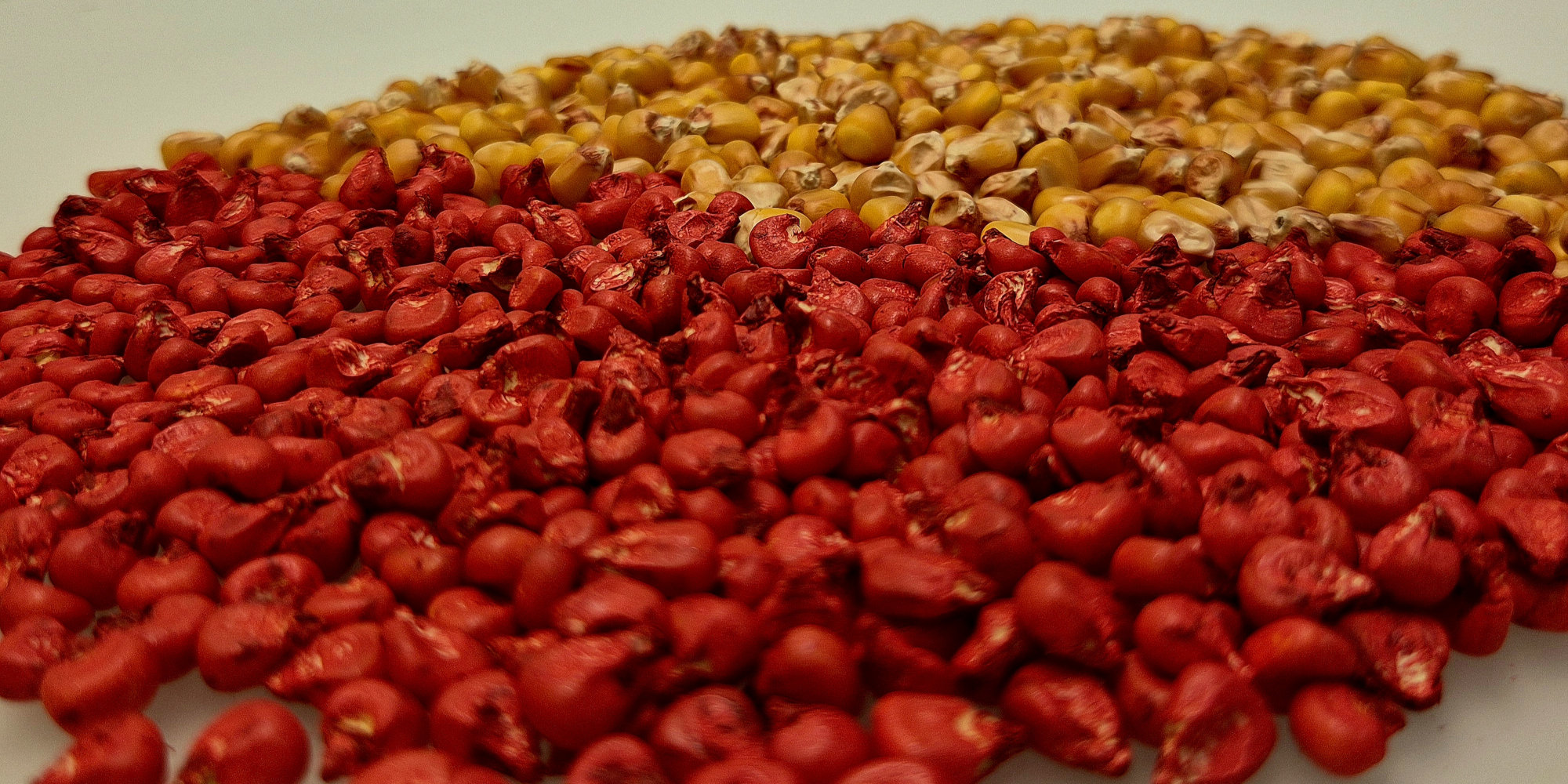
Fungicide seed coatings protect seeds and safeguard yields, but can adversely affect beneficial soil fungi. Recent findings from various experimental systems – from controlled laboratory trials to real-life conditions in the field – show how dramatically these effects can vary.
Fungicide seed coatings are common in agriculture to protect young plants from diseases and ensure stable yields. However, fungicides may also negatively impact non-target organisms, such as beneficial soil biota, in addition to harmful fungi. Among these beneficial organisms are arbuscular mycorrhizal fungi, which can improve plant nutrient uptake and soil structure. In policy and administrative circles, striking a balance between ensuring stable yields and promoting ecological functions is a key concern, e.g. in the context of sustainable farming and soil health. Previous evaluations of seed coatings often focused on short-term effects or individual aspects, paying less attention to how impacts may differ across a range of levels – from the spore, to the field performance of mycorrhizal fungi. Recent research provides nuanced insights into this issue and shows that the impacts are not uniform.
Different effects depending on experimental system
The study shows that fungicide seed coatings in maize affect mycorrhizal fungi differently, depending on scale. At the level of individual fungal spores, germination can be significantly inhibited. These effects, however, cannot be extrapolated directly to plant growth or to maize yields in the field. This means that the informative value of individual laboratory tests for real-world use comes with caveats.
Attenuation of effects in the field
The negative effects of fungicide seed coatings on mycorrhizal fungi are less pronounced in the field trial than under controlled laboratory conditions. Environmental factors such as soil characteristics, microorganisms and climatic conditions influence the real-world effect. In many cases, the plants remain colonised with mycorrhiza – although to a lesser extent – despite the seed coating.
Limited impact on plant performance
As a rule, the application of fungicide seed coatings has only a slight effect on the colonisation of the maize roots with mycorrhiza and on the resulting plant performance. Whilst individual effects on the symbiosis between plant and fungus are visible, these do not necessarily lead to measurable losses in agricultural production. This suggests that plants and soil organisms possess a certain ability to adapt to seed coatings.
Conclusions
- Results from laboratory studies with fungicide seed coatings should not be extrapolated directly to field conditions. Depending on the experimental system – ranging from controlled laboratory trials to real-world conditions in the field – the effects of seed coatings on mycorrhizal fungi vary dramatically.
- In addition, real-world conditions such as site factors and soil management significantly influence the actual effects on the arbuscular mycorrhizal fungi.
- With the fungicides tested here, targeted, low-dose applications, as in the case of seed coatings, have little impact on the soil microbiome.
Bibliographical reference
Scale-dependent effects of fungicide seed coating on arbuscular mycorrhizal fungi: from spore germination to field performance.