Climate Change to Redraw European Viticulture
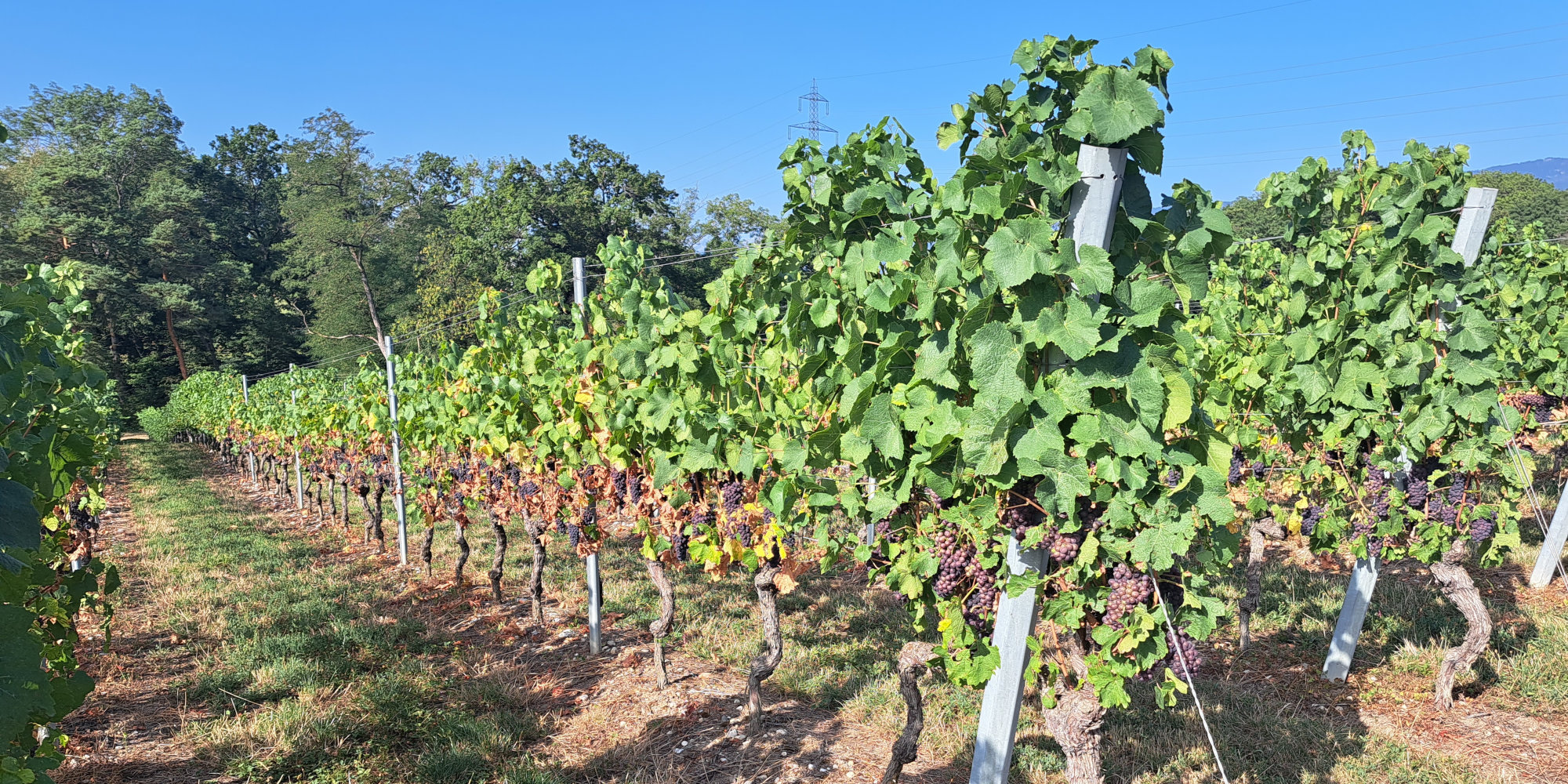
Photo: Pierre-Henri Dubuis,
Agroscope
Where in Europe will tomorrow’s wine be produced? A study based on climate analogues shows that global warming will redefine the wine-growing regions, with diseases playing a vital role.
Global warming is already altering grapevine-growing conditions in Europe. In the future, certain traditional wine-growing regions risk becoming less suitable, while others could gain in potential. The present study analyses these developments by comparing the future climate of vineyards to current similar climates referred to as “climate analogues”.
The originality of the approach rests on the use of bioclimatic indices directly associated with the vine and its diseases. Three indices describe growth conditions and three others evaluate plant-health risks such as downy and powdery mildew or flavescence dorée (grapevine yellows). The study also includes local topography – essential for understanding vineyard microclimates.
Climate- and disease-dependent shifts
The findings reveal contrasting dynamics: in general, increasing temperatures are pushing the suitable regions northwards and towards higher altitudes. Several southern European regions could become too hot for viticulture. By contrast, diseases associated with humidity are pushing analogues eastward or westward, depending on local conditions. Overall, by 2080, the majority of the climate analogues of European vineyards will be located further south.
Limits to expansion and the challenges of adaptation
According to the study, plant-health risk is expected to increase in numerous regions. Downy and powdery mildew are expected to advance in central and northern Europe, while flavescence dorée could progress towards new regions. Thus, even if certain northern regions become thermally adapted, disease pressure could limit their winegrowing potential.
Mountain regions offer more-balanced conditions, but their use remains difficult and costly. In this context, adaptation will entail changes in grape varieties, growing practices and, in certain cases, a shift in production regions.
The findings of this study are included in the ‘Climate Analogues – Vines’ app, which illustrates the future climatic conditions of grapevine parcels in Europe by 2090 (see ‘Further Information’).
Conclusions
- Climate change will profoundly alter the distribution of vineyards in Europe.
- Rising temperatures are pushing wine-growing regions northwards and towards higher altitudes. Diseases associated with humidity are severely limiting this expansion, particularly in northern Europe.
- Several southern regions could become unsuitable for viticulture in the long term. Mountain regions offer alternatives, but with economic and technical constraints.
- Adaptation will entail changes in grape varieties, growing practices, and, in some cases, location.
Bibliographical reference
Future viability of European vineyards using bioclimatic climate analogues.