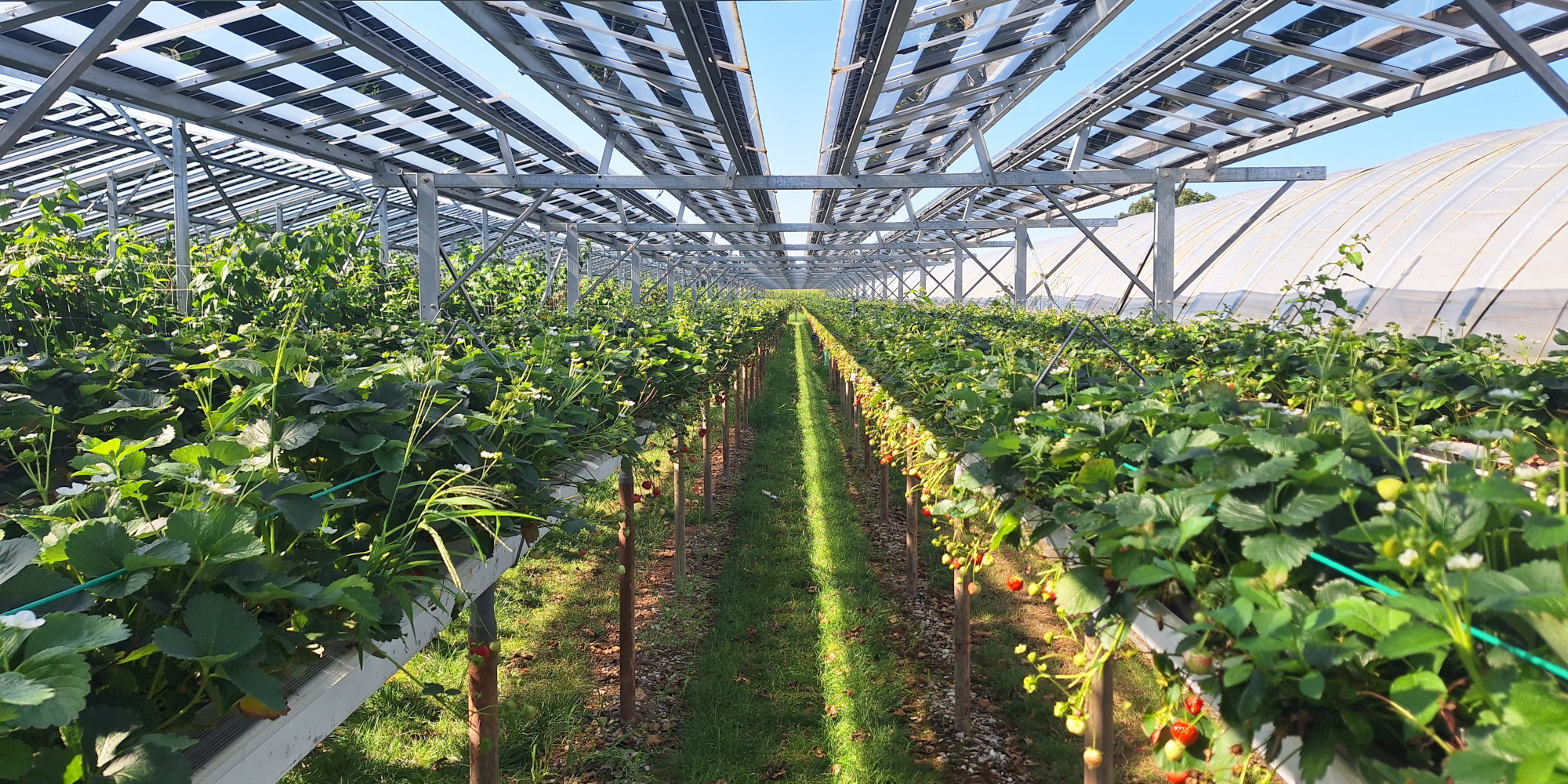
More Light, Higher Yield: Strawberries React More Sensitively to Shading than Raspberries
Photo: Agroscope
In Switzerland a large proportion of strawberries and raspberries are grown under protective structures that could be combined with agrivoltaic systems. A study conducted by Agroscope and Insolight investigated how shading impacts yield and fruit quality and calculated threshold values.
In Switzerland around a third of strawberry crops and three-quarters of raspberry crops are cultivated under or in protective structures such as tunnels or greenhouses to protect them from bad weather and extend the growing season; however, rising summer temperatures jeopardise crop yield and quality. This fuels an interest in agriphotovoltaic (agri-PV) systems, which combine power generation and agriculture. The downside of agri-PV systems is that excessive shading can negatively affect crop performance.
Over four years (2021−2024), Agroscope and Insolight conducted 21 case studies in Switzerland to determine the influence of different shading structures, including 13 agrivoltaics configurations, on strawberry and raspberry crop yields.The effects of the amount of light per square metre per day on fruit yield, average fruit weight, firmness, and sugar and acid content were analysed.
Strawberries react more strongly to shading
The results show that yield and sugar content decreased for both types of berries along with decreasing amounts of light, the effect being stronger with strawberries. Strawberries require more light and suffer more under shading than raspberries. For strawberries, the authors recommend a daily mininum amount of light of 25 moles of photons per square metre. In the trials, this corresponded to an estimated overall shading of 10–30%, depending on type of cover. The firmness of the strawberries also declined with decreasing amounts of light.
Raspberries are more shade-tolerant
Increasing shade also led to a reduction in raspberry yields, albeit a less pronounced one than for strawberries. This confirms previous observations that raspberries are more shade-tolerant due to their evolutionary origins in woodlands. The authors recommend a minimum of 15 moles of photons per square metre for raspberries in order to avoid excessive yield losses. Furthermore, unlike with strawberries, the shading had no negative impact on the sweetness of the fruit.
By contrast, fruit weight and acid content of both strawberries and raspberries were not influenced by shading.
Species-specific light requirements important when designing agrivoltaic systems
The results provide clear thresholdvalues for developing agrivoltaic systems that ensure high-quality berry protection whilst generating renewable energy. The study shows that species-specific sensitivity to light should be taken into account when designing agrivoltaic systems with a view to optimised agronomic performance.
Conclusions
- Strawberries are more sensitive to shading than raspberries and require at least 25 moles of photons per square metre to achieve optimal yields and quality.
- Raspberries are more shade-tolerant, and can get by on a minimum of 15 moles of photons per square metre.
- Increased shading causes a decrease in the firmness of strawberries, whilst having no negative impact on the sweetness of raspberries.
- The study shows that species-specific light requirements should be considered when developing agrivoltaics systems with a view to achieving optimal agronomic performance.
Bibliographical reference
Light Thresholds and Shading Effects on Strawberry and Raspberry Yields and Quality Under Agrivoltaics Systems in Switzerland.