Flavescence Dorée: Introduction and Propagation in Western Switzerland
Photo: Carole Parodi,
Agroscope
For the first time, a genetic analysis provides a detailed image of how flavescence dorée spreads in Swiss vineyards north of the Alps, showing that infected planting material and local dissemination both contribute to the growth of the epidemic.
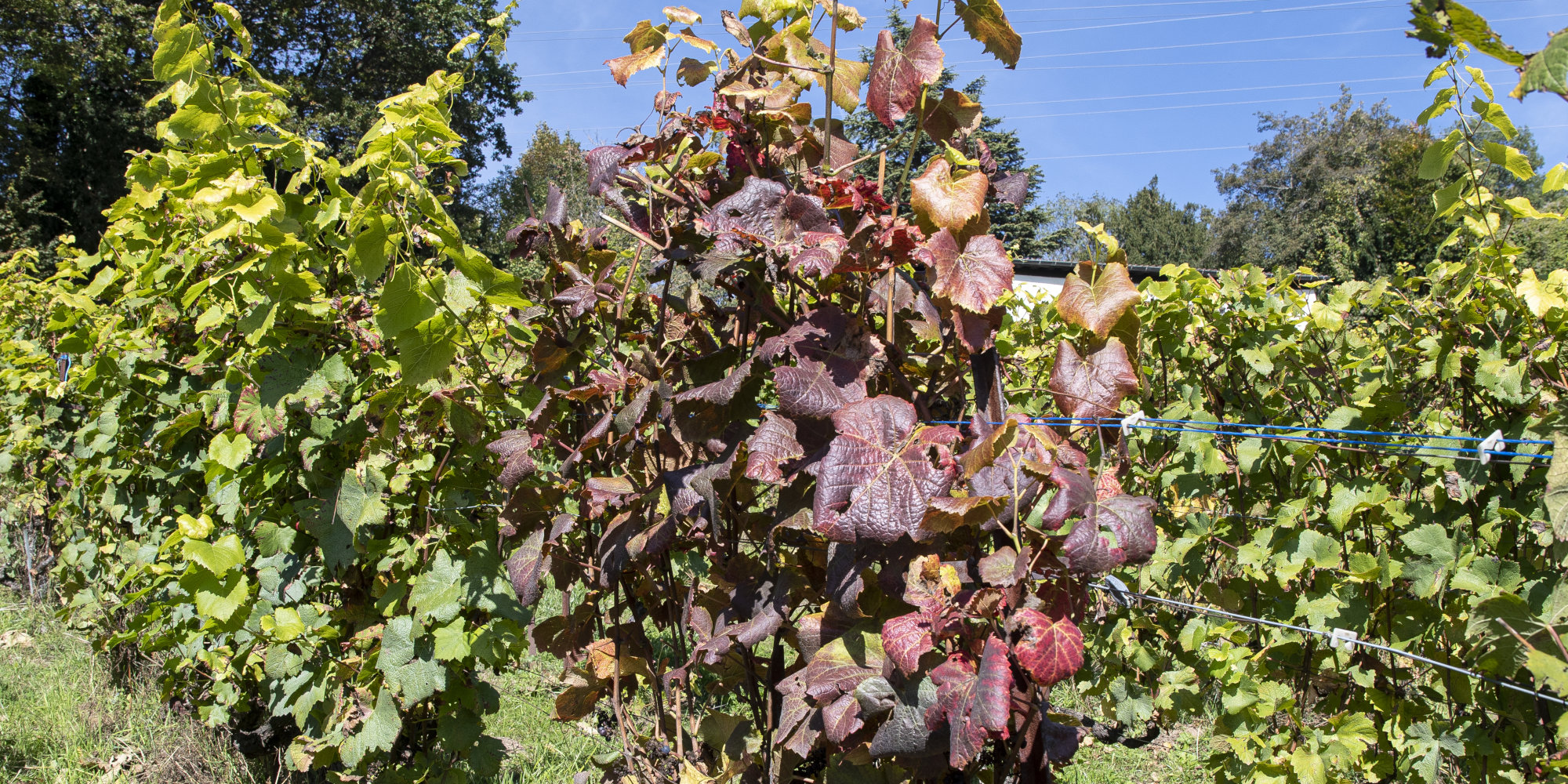
Flavescence dorée (FD) is a severe disease belonging to the ‘grapevine yellows’ category. FD is associated with a phytoplasma – a cell-wall-less bacterium classified as a quarantine organism. This phytoplasma is transmitted from vine to vine by an insect vector – the leafhopper Scaphoideus titanus. To date, there is no known curative treatment for the disease, and current control measures rely on the compulsory and systematic uprooting of all infected vines, insecticide control of the vector in regions where the disease is present, and territorial monitoring. Although FD has been spreading north of the Swiss Alps since 2015, the mechanism of its arrival in western Switzerland had been unclear until now.
Two diseases with identical symptoms
Between 2015 and 2022, Agroscope analysed 4212 samples of grapevines exhibiting symptoms of yellowing collected by the plant-health services of the cantons of Vaud, Valais and Geneva. The analyses showed that 26.3% of the samples were indeed infected with FD, whilst close to half exhibited a disease with identical symptoms – bois noir – associated with a different phytoplasma. Dual infections were rare, with a rate of 0.17%.
Genetic clues for the origin of the disease
Genetic analysis of the phytoplasm strains using several reference markers revealed very low diversity north of the Alps. All of the samples shared a characteristic profile of the ‘grapevine-leafhopper’ epidemiological cycle observed in numerous European wine-growing regions. These findings suggest that the disease is likely to have been introduced through the planting of already infected propagation material. By contrast, introduction resulting from transfer from a reservoir present in the surrounding landscape seems much less likely, although the potential role of these reservoirs is still the subject of research in Switzerland.
Different propagation dynamics depending on region
A more in-depth genetic analysis revealed the existence of three distinct genetic groups with a well-defined geographical spread. To better understand the local distribution of the phytoplasm, Agroscope developed genetic markers capable of distinguishing between very closely related strains. These tools showed that the spread of flavescence dorée does not follow the same pattern everywhere, and that it is influenced by the features of the landscape as well as by human activity:
- In Lavaux, two homogeneous populations that are clearly geographically segregated can be observed. In particular, the motorway could represent a barrier limiting the movements of the leafhopper vectors.
- In central Valais, a uniform genotype suggests a single introduction followed by local dissemination.
- Genetic diversity is higher in Chablais. Some infected plots are located at a distance of over three kilometres, and the natural flight range of the leafhoppers is probably not sufficient on its own to explain this dispersal. Other mechanisms such as the exchange of planting material or the passive transport of the leafhoppers through human activity or the wind could also contribute to the spread of the disease.
This study is the first to provide a high-resolution genetic snapshot of the flavescence dorée situation north of the Swiss Alps. It shows that the planting of infected propagation material is highly likely to be the source of the epidemic, and that, along with natural transmission by the leafhoppers, human activities have also played a role in FD dispersal.
Healthy plants and new markers support monitoring
The prevention of new introductions is based first and foremost on the use of certified, hot-water-treated plants. The management of the disease requires the removal of infected grapevines, as well as the control of leafhopper vectors using insecticides.Lastly, taking prophylactic measures such as cleaning agricultural material between plots and organising vineyard tasks to prioritise healthy plots before infected ones will help reduce the risk of phytoplasma spreading.
These recently developed genetic markers enable local outbreaks to be monitored with greater precision and could be tested in other wine-growing regions in Switzerland and Europe in the future.
Conclusions
- This study provides the first high-resolution genetic characterisation of flavescence dorée outbreaks north of the Swiss Alps.
- Flavescence dorée and bois noir cause visually identical symptoms: only genetic analysis enables the disease in question to be identified with certainty.
- It is highly likely that the disease was introduced into western Switzerland via infected planting material.
- Dissemination patterns vary according to region and show that the spread of the disease is caused both by the movements of the leafhopper vector and by human activity.
- In practice, the use of plant material treated with hot water is vital, as this method is at present the only one capable of guaranteeing the absence of the phytoplasma in the plants.
- Recently developed genetic markers allow a more precise monitoring of the chains of infection and may improve disease monitoring and control in a targeted manner.
Bibliographical reference
High-resolution SNP genotyping provides insight into the introduction and dissemination of Grapevine flavescence dorée phytoplasma in Switzerland.