Adaptable and High-Yielding: Multispecies Mixtures Make Sown Grasslands Climate-Change-Proof
Photo: Gabriela Brändle,
Agroscope
Mixtures of several forage-plant species systematically increase yields with lower fertiliser input. Higher temperatures enhance the benefits of these mixtures, making them a key component of climate-change adaptation.
Cultivating forage-plant species as mixtures improves resource efficiency. Agroscope investigated this in a global study recently published in the journal Science. Mixtures of several forage plants systematically increase yields with lower fertiliser input. Higher temperatures enhance the benefits of these mixtures, making them a key component of climate-change adaptation.
Worldwide network of 26 experimental sites
The study summarises the findings of a global network of experiments conducted on 26 sites around the world in the temperate climate zone. Agroscope, the Swiss Confederation’s centre of excellence for agricultural research, carried out the experiment together with partners from Europe, North America, China and New Zealand.
Six species give greater yields than one or two
In Switzerland, only mixtures of more than two forage plants are sown in the rotation. In many other countries, and for simplicity’s sake, it is mostly grass monocultures (which require high nitrogen-fertiliser input) or a combination of just one grass and one legume that are sown. The Swiss strategy of planting mixtures of several species is now also catching on internationally. Researchers investigated which mixtures of up to six different forage-plant species would improve yields whilst lowering dependence on nitrogen fertilisers.
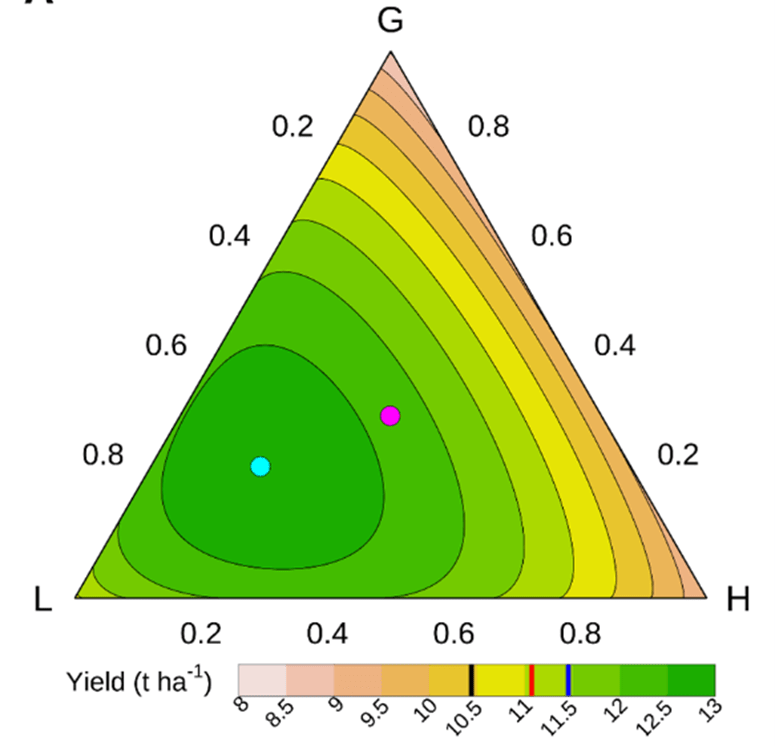
The findings showed that grassland mixtures of several species achieved higher yields than the monocultures due to beneficial interactions between the species. The mixtures yield was much higher than the sum of the individual parts. A mixture of grasses, legumes and herbs delivered an 11% higher yield than a grass monoculture receiving more than twice as much nitrogen fertiliser, and an 18% higher yield than a simple grass-legume mixture with the same fertiliser input.
The warmer the climate, the greater the yield advantage of multispecies mixtures
And further good news – the study shows that warmer temperatures enhance the advantages of grassland mixtures. With increasing temperatures, the yield advantage of the multispecies mixtures with legumes and herbs rose along the climatic gradient of the sites, underscoring the potential of mixtures for climate-change adaptation.
It was not just in Switzerland that multispecies mixtures had an advantage. The study demonstrates convincingly that this Swiss tradition also improves resource efficiency worldwide and supports agriculture’s adaptation to climate change.
Conclusions
- A global network tested forage-plant mixtures of two grasses, two legumes and two herbs in order to further develop more-sustainable cropping systems in forage production.
- Forage-plant mixtures of six species, including legumes, were higher-yielding than systems composed of pure grass species or of a two-species mixture of grass and legume that are still common in other countries.
- The yield increase of the multispecies mixtures rose with increasing site temperature. This shows that in the face of climate change, such mixtures can help safeguard forage-production yields.
Bibliographical reference
Multispecies grasslands produce more yield from lower nitrogen inputs across a climatic gradient.