Japanese Beetle Surveillance: Ensuring Monitoring, Reducing Bycatch
Photo: Patrik Kehrli,
Agroscope
Traps for monitoring Japanese beetle also capture other insect species. An Agroscope study shows that the incidental capture of non-target organisms (‘bycatch’) is low overall. Nonetheless, simple adjustments could considerably reduce beetle bycatch without lessening the informative value of the surveillance.
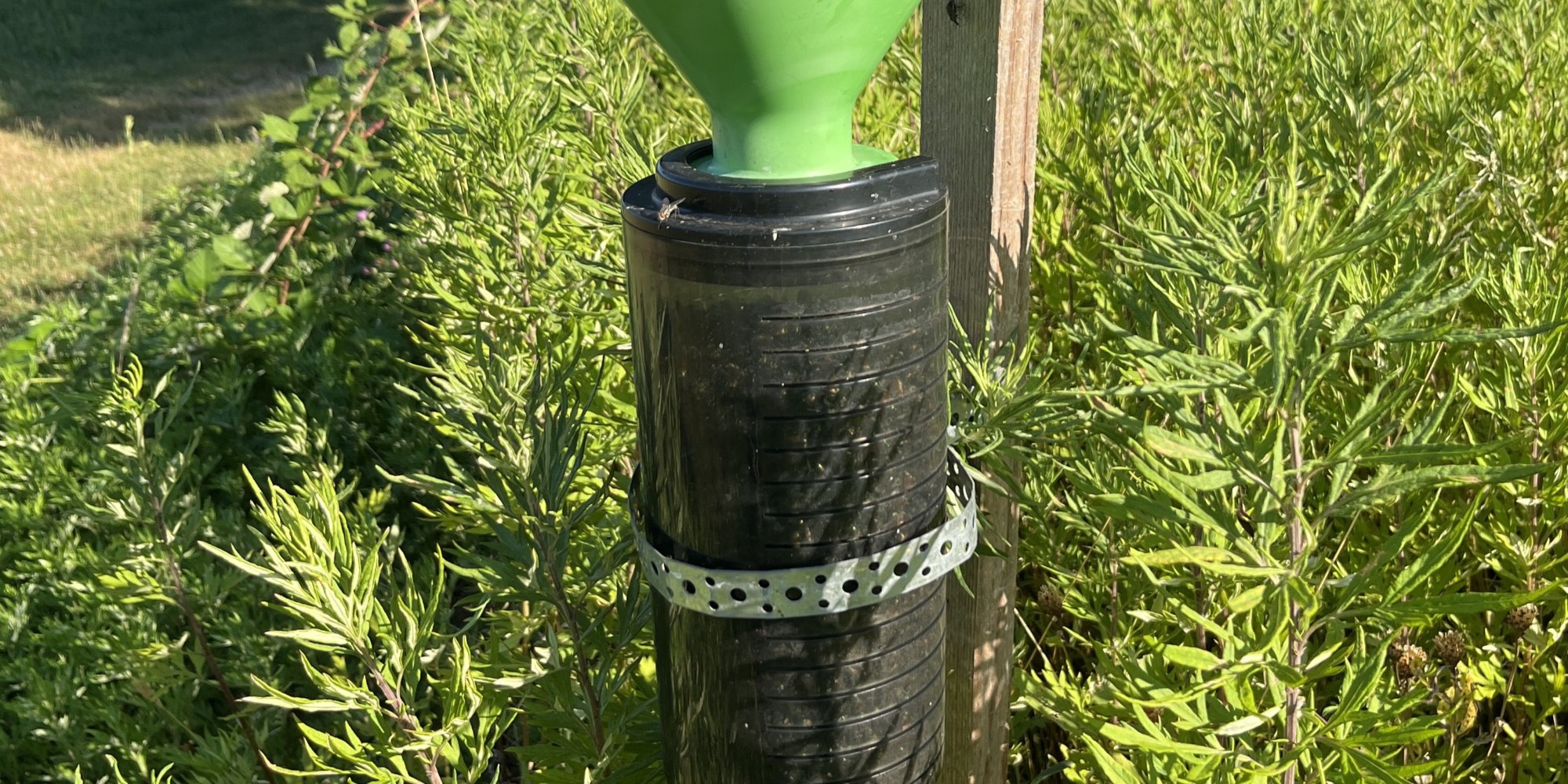
Native to Northeast Asia, the Japanese beetle (Popillia japonica) is a scarab beetle which causes significant economic damage to crops and ornamental plants and has been present in Switzerland since 2017. The Japanese beetle is classified as a priority quarantine organism both in Switzerland and in the EU,and is therefore subject to mandatory surveillance throughout Switzerland. For this, pheromone traps are used which, owing to their visual lures as well as the olfactory composition of the attractant, also attract and capture other insect species besides the Japanese beetle. The term ‘bycatch’ describes these accidentally captured non-target organisms. The Swiss Federal Plant Protection Service (SPPS) has tasked Agroscope with assessing this bycatch and formulating adjustments to avoid the capture of non-target species.
Recording bycatch during the surveillance of Japanese beetle
On behalf of the SPPS, cantons monitor the presence of the Japanese beetle. In 2025, we investigated the recorded bycatch of 11 cantons at 19 selected sites of the Swiss Japanese-beetle trap surveillance network, focusing in particular on endangered species and pollinators.
Composition and scale of bycatch
In the total of 189 samples, 3565 bycatch specimens were recorded, with beetles accounting for by far the largest share of these (nearly 95%). Of the 3377 beetles captured, almost 99% of all specimens were scarab beetles, the garden chafer (Phyllopertha horticola) clearly dominating with 3141 captured specimens. In addition, ten potentially endangered white-spotted rose beetles (Oxythrea funesta) as well as 50 honeybees, 31 bumblebees, 14 wild bees and 12 paper wasps were captured. Whilst we consider the amount of incidentally captured pollinators to be acceptable, beetle bycatch could be considerably reduced with easily implementable adjustments.
Approaches for reducing bycatch
Firstly, traps at high altitudes with high densities of garden chafers could be set up no earlier than July, or even mid-July. Secondly, this later start of capture could also be used to reduce the bycatch of the white-spotted rose beetle throughout its distribution range, and in particular along the Rhone. These adjustments could significantly reduce insect bycatch numbers – in our opinion, without substantially lessening or even jeopardising the informative value of the Japanese-beetle surveillance.
Conclusions
- Pheromone traps for monitoring Japanese beetle attract not only adult Popillia japonica but also closely related scarab-beetle species as well as additional individual beetle and insect species.
- In areas of low biodiversity (intensive farming areas or settlement areas), this incidental capture of non-target organisms is of little consequence.
- Traps and bycatch in high-biodiversity habitats (extensively managed or undisturbed areas) have more serious implications, since numerous rare or endangered species occur there. At such sites, bycatch numbers could easily be reduced by implementing the following two adjustments:
1. At high altitudes with high densities of garden chafers and in undisturbed areas, traps should be set up no earlier than July.
2. Refrain from setting up traps throughout the distribution range of the potentially endangered white-spotted rose beetle, and in the Rhone Valley in particular, before July.
Bibliographical reference
Insektenbeifänge bei der Überwachung des Japankäfers.