The Significance of the Agricultural Policy Goals for the Swiss Population
Foto: Carole Parodi
Agroscope
This article summarises all papers published by Agroscope and ETH that deal with the perception of agricultural policy of both farmers and the rest of the population. It highlights what must be borne in mind when developing policy measures so as to achieve broad acceptance of an integrated agricultural and food policy.
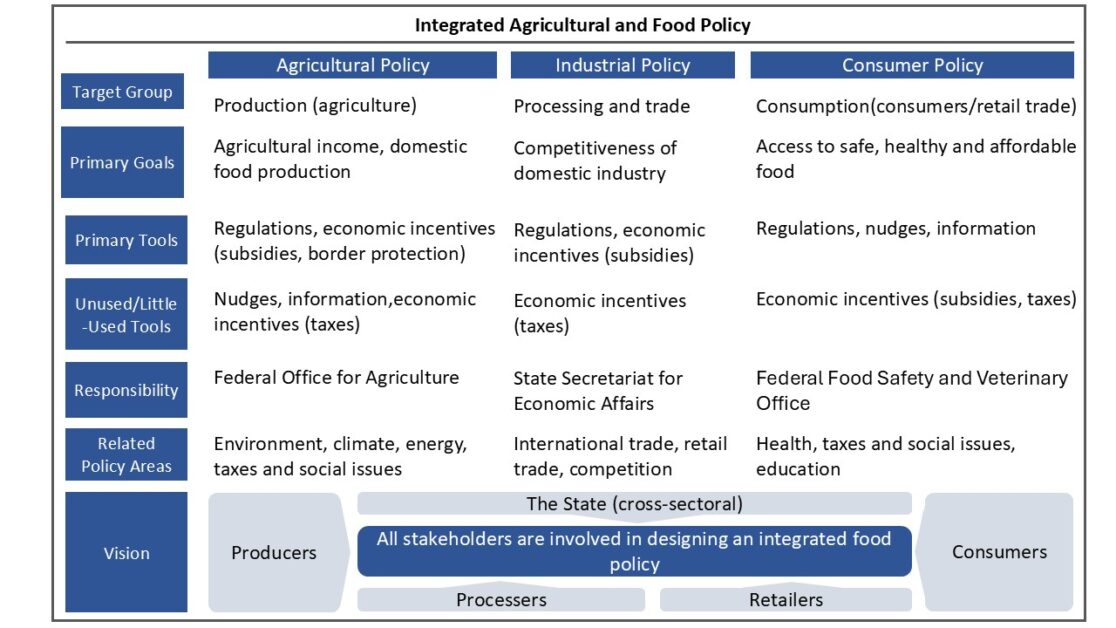
An effective agricultural and food policy requires a common understanding of goals and a mix of measures geared to achieving the latter. The Swiss population is largely in agreement over the goals of agricultural policy and views all stakeholders as being jointly responsible for goal achievement. In this context, the State has also been assigned a role in food policy measures. In order to promote sustainable production and consumption decisions, coordinated policy measures along the entire food value chain are essential. In order to take the right measures, it is crucial to know the existing preferences of both farmers and the rest of the population.
Three surveys highlight agricultural and food policy preferences
The Agroscope/ETH project is based on data from three questionnaires evaluated by means of descriptive statistics and regression analyses. The first questionnaire (October 2022) recorded the preferences of agricultural policy goals and trade-offs in the Swiss population in an online sampling of 1542 people from three linguistic regions. The second questionnaire (February 2023) investigated the acceptance of 19 information-, incentive- and restrictions-based measures for promoting an environmentally friendly diet in an online survey of 453 people from German-speaking Switzerland. The third questionnaire (June–August 2023) asked 882 farmers from German- and French-speaking Switzerland on their preferences for agricultural policy goals in order to compare these with those of the non-farming population.
How agricultural policy goals are viewed
The Swiss population ascribes great importance to agricultural policy goals, with animal welfare being clearly prioritised, followed by agricultural income. Low food prices and higher domestic production are less important. Preferences vary strongly according to political attitudes: Left-leaning individuals prioritise environmental goals, right-oriented individuals rank production goals higher. Animal welfare is less polarising and is frequently prioritised where trade-offs exist. Regional differences exist between linguistic regions, but are almost non-existent between urban and rural areas, and farmers and non-farmers share many priorities.
How agricultural and food policy measures are viewed
Broad agreement on the diverse agricultural policy goals legitimises measures for a multifunctional agricultural sector, with more environmentally friendly production only being achievable when agricultural incomes are secured. A balanced approach to reform that takes equal account of environmental goals, farmers income and food prices whilst avoiding polarisation is required here. The population shows a systemic understanding and views responsibility as being shared between the State, producers, industry and retailers, and consumers. Measures targeting consumers find greater acceptance when State responsibility is clearly communicated. All in all, this speaks in favour of a coherent policy mix of regulatory measures, economic incentives, behaviour-based tools (‘nudges’) and informational tools such as quality labels, extension advice and training programmes.
Conclusions
- Although the population rates all agricultural policy goals as important, a large majority prioritises animal welfare over other goals.
- Preferences for agricultural policy goals vary mainly according to political orientation and linguistic region, rather than between urban and rural regions.
- Measures for greater environmental protection and animal welfare in agricultural production are only accepted and implemented when they do not lead to loss of farm income.
- A coherent policy mix with shared responsibility among all stakeholders – producers, consumers, industry, retailers and the State – increases the acceptance of food policy measures.
- Food policy measures should be presented as contributing to common societal goals.
- A mix of regulatory measures, economic incentives, behaviour-based tools (‘nudges’) and informational tools should be used from production to consumption.
Bibliographical reference
Welche Bedeutung haben die agrarpolitischen Ziele für die Schweizer Bevölkerung?.